
When Does Marketing Become Annoying Noise?
There’s a moment when marketing stops being helpful and starts being ANNOYING. Not because the product is bad. Not because the brand lacks awareness. But because the relationship side of things has been ignored or abused.
That line was crossed last week.
The Case Study: When Too Many Touchpoints Cross the Line
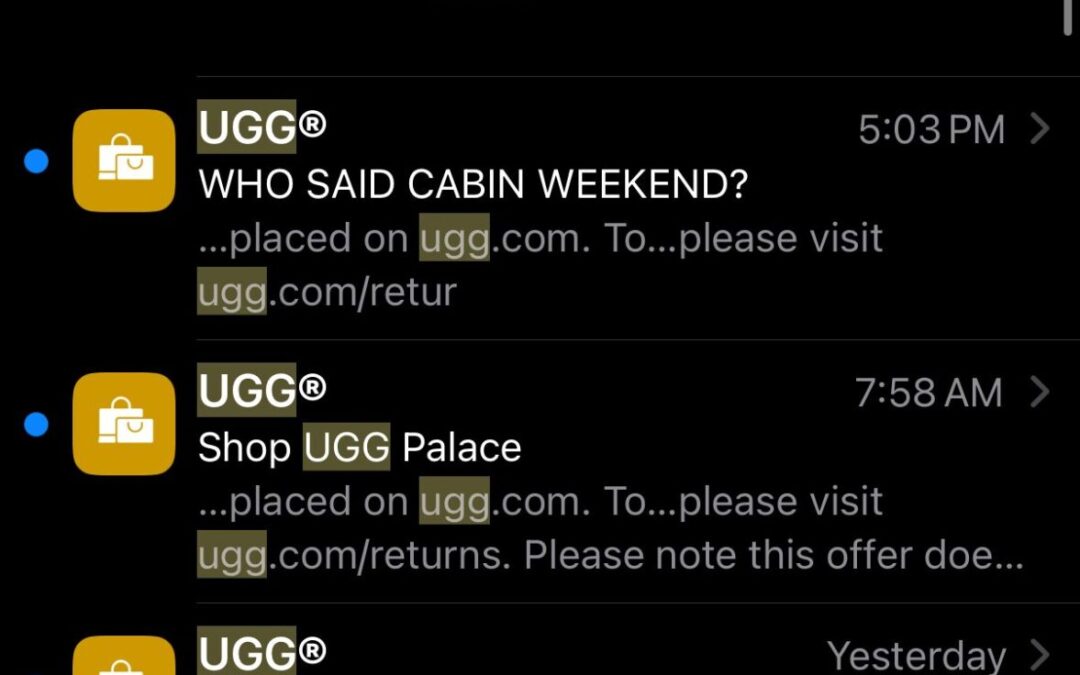
I ordered a pair of UGG boots as a Christmas gift. In seven days, I received:
- 7 emails related to that single order
(left in cart, ordered, processed, shipped, out for delivery, delivered, please take a survey) - 22 additional promotional emails
pushing unrelated products
That’s 29 emails in one week from a brand I already said yes to.
At no point did I feel nurtured. I felt my permission was being abused.
And here’s the important part:
All of these 22 additional emails didn’t make me more likely to buy again. Instead, they gave me the ‘ick’ in young people terms. It made me emotionally disconnect from a great product. It made me like the gift choice less. And, it made me unsubscribe — and complain about the brand to others [i.e., write this blog!]
That’s not a marketing win. That’s a REALATIONSHIP FAILURE.
The Core Problem: Activity Over Value
Here’s the line that matters: Marketing becomes noise the moment it prioritizes activity over value – and volume over relationship.
Or, put more bluntly: Marketing that ignores trust progression doesn’t just fail—it actively erodes brand equity.
UGG didn’t misunderstand email automation. They misunderstood context.
I wasn’t a prospect. I wasn’t a lead. I was a already a customer.
And customers don’t want to be treated like unfinished transactions.
Return on Relationship (Ted Rubin Was Right)
Ted Rubin calls it Return on Relationship – the idea that trust, relevance, and human connection outperform brute-force marketing every time.
What I experienced felt like something else entirely. Repeated, non-personalized messages with zero added value quickly erased whatever trust existed—and replaced it with annoyance.
At that point, the outcome was predictable: unsubscribe.
Ted is right. There is no relationship without relevance. And brute-force marketing doesn’t just fail to build relationships—it actively undermines them by adding no value and destroying trust.
Aside: Maybe it’s time marketers start paying closer attention to a metric that actually reflects trust erosion: how quickly customers opt out when relevance disappears. We can call it ROU: Rate of Unsubscribe!
Modern Marketing Is Interruptive – And, That’s Okay, When Done the Right Way
This is an important nuance – and one John Starkweather has articulated well over the years.
All marketing interrupts something: Time. Attention. Flow.
That’s the deal we make as marketers.
But, just because platforms give brands permission to show up doesn’t mean audiences give permission to waste their time.
When you interrupt someone – whether it’s a commercial, a promoted post, or an email – you owe them something in return: Value. Perspective. Entertainment. Helpfulness… A reason to stay.
If the interruption isn’t worth it, people don’t just tune out. They skip. They scroll. They unsubscribe…. Or worse – they push back.
That’s not because people hate marketing. It’s because they’re protecting their time and attention. And once those are abused, is hard to earn back.
Progression to Trust vs. Progression to Annoyance
A framework I often use (and credit to John Starkweather’s work) is Progression to Trust – how influence grows as control decreases:
- Brand → Customer
- Celebrity → Customer
- Analyst → Customer
- Peer → Customer
- Friend → Customer
Trust increases as the message becomes more human and is less controlled by the brand. But there’s a dark mirror to that model – what happens when marketing loses the plot.
Progression to Annoyance
- Helpful – timely, relevant, expected
- Redundant – same message, no new value
- Excessive – frequency outweighs usefulness and value
- Intrusive – feels like chasing
- Distrust – unsubscribe, avoidance, negative word-of-mouth
The rule is simple: Trust compounds through relevance. Annoyance compounds through repetition.
Most brands don’t notice when they cross the line – because their dashboards reward sends, not sentiment.
The Real Miss: They Ignored the Relationship
What bothered me most wasn’t just the number of emails. It was what wasn’t there:
- No acknowledgment that I already purchased
- No recognition of seasonality (this was a holiday gift)
- No curiosity about why I bought
- No respect for my attention
Instead of learning about me, the brand talked at me.
That’s not modern marketing. That’s digital noise. More irrelevance. More annoyance.
The 8 Purposes of Content (And How Ugg Failed)
I often say content should do more than promote. At its best, it serves at least one of these purposes:
- Inform / Educate
- Motivate / Inspire
- Humanize / Connect
- Position / Lead
- Recognize / Reward
- Entertain / Delight
- Engage / Converse
- Promote / Brag
Of the 29 emails I received? Only two boxes were checked:
- Status of the order: Inform
- All of the others: promote, Promote, PROMOTE
When promotion is the only note you play, people stop listening.
What Good Marketing Could Have Looked Like
This isn’t complicated. It just requires intentionality and purpose.
A better post-purchase experience might look like this:
- Order confirmation (necessary)
- Shipping and delivery updates (useful)
- A care tip or usage idea (value)
- One simple question:
Do you want to hear about other products – or just order updates?
Or, would you like help finding other thoughtful holiday gifts?
That’s it.
Permission is the highest form of personalization.
Why Some Marketing Works (And This Didn’t)
Disruptive marketing can work – when it earns the interruption. The campaigns we remember tend to do at least one thing well:
- They entertain
- They demonstrate real value
- They respect the audience’s intelligence
Noise interrupts. Value earns attention.
The Bottom Line
Marketing doesn’t fail because it interrupts. It fails because brands forget there’s a human on the other side of the message. It fails when those interruptions add no value and ignore the relationship.
If your marketing would annoy you, then it will annoy your customer.
And once trust erodes, no amount of follow-up emails will win it back.
As for me, I hit unsubscribe and decided to write this blog.


#Marketing #EmailMarketing #ProgressionToAnnoying #ROR #ReturnOnRelationship
If you want a simple, guided way to tighten your digital footprint before January, download the free End-of-Year Career Guide here:
➡️ www.validatedbyknox.com/career
Give me a follow on LinkedIn
➡️ www.linkedin.com/in/knoxkeith