
Everyone seems to be complaining about AI-generated job applications.
Candidates are using ChatGPT to write resumes. They’re tailoring cover letters with AI. They’re stuffing applications with the right keywords. And, recruiters complain that every resume sounds the same. Hiring managers complain that candidates don’t sound authentic anymore.
And apparently, we’re surprised by this.
But before we blame applicants for gaming the system, maybe we should ask a more uncomfortable question:
Who built the game they’re trying to win?
Because job seekers didn’t automate hiring first. Employers did.
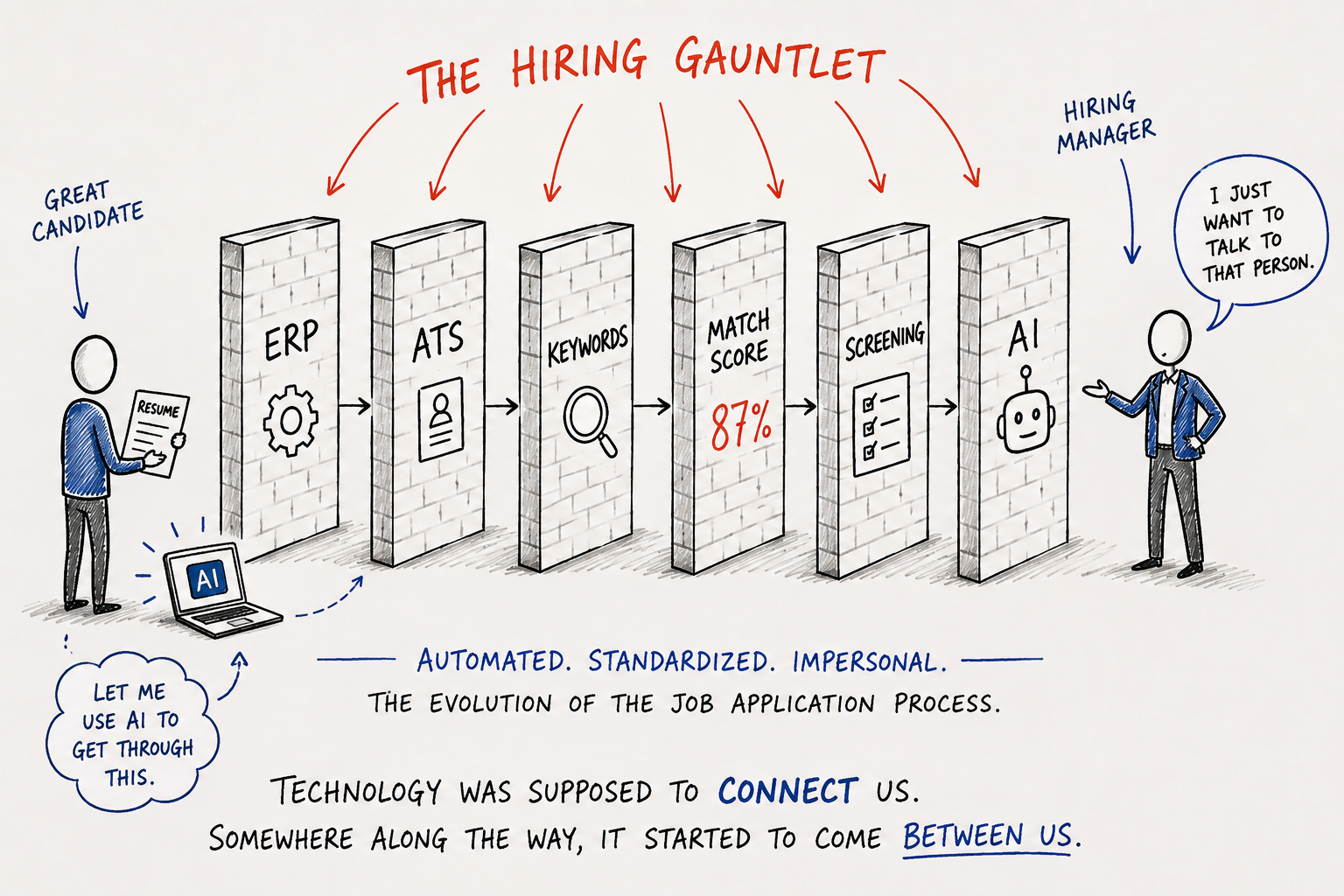
For years, companies have invested enormous amounts of money in ERP platforms, Applicant Tracking Systems (ATS), automated screening tools, keyword matching and standardized recruiting processes. There were legitimate reasons for doing it. Companies needed to process larger applicant pools. HR needed consistency. Organizations wanted efficiency, compliance and broader access to wider applicant pools.
All reasonable goals.
But somewhere along the way, we didn’t just automate the administration of hiring. We started automating judgment.
And those aren’t the same thing.
The Best Candidate Isn’t Necessarily an 87% Match
I’ve been a hiring manager. And I don’t particularly care whether a system says someone is an 82%, 87% or 94% match for a job description. I care whether they can do the job. Actually, that’s not quite right. I care whether they can become great at the job.
Those are two very different questions.
Job descriptions are snapshots. Jobs aren’t.
Roles evolve. Organizations change. Priorities shift. Technology changes. Teams change. The person I hire today may be doing something significantly different 18 months from now.
So I’m looking for a baseline of capability. I’m looking for transferable skills. I’m looking at how someone thinks. How they solve problems. Whether they’re curious. Whether they can learn. Whether they can work with the team. Whether they have the attitude and adaptability to grow into what the job becomes. And yes, I’m looking for fit.
A good manager can train skills. It’s a lot harder to train curiosity, judgment, adaptability and attitude.
An ATS can tell me whether someone’s resume contains the things we’ve told it to look for. That’s useful. But a match score can identify similarity. Human judgment still has to identify potential.
HR Doesn’t Know My Job Like I Do
This is where the process gets even more complicated. HR plays an incredibly important role in recruiting. But when I’m the hiring manager, nobody in HR understands the actual job the way I do. They shouldn’t. They’re not doing it every day.
I know which requirements on the job description are truly essential and which ones aren’t. I know which skills I can teach in three months. I know why someone with experience in a completely different industry might bring exactly the perspective my team needs. I know the personalities on my team. I know where we’re weak. I know where we’re headed. I know the problem I’m actually trying to solve by hiring someone.
An applicant may look imperfect against the job description and perfect against the problem. But the more filters we put between that person and the hiring manager, the less likely the hiring manager is to ever meet them.
That’s not necessarily better hiring. It’s better processing.
Efficiency is not the same thing as effectiveness.
We Also Broke Networking
There’s another unintended consequence we don’t talk about enough. We made it harder for people to network their way into opportunities. And I don’t mean some shady backdoor process where the CEO’s nephew gets the job. I mean actual networking.
For decades, one of the smartest things a job seeker could do was learn about a company, find people inside it, understand the business, identify the hiring manager and start conversations.
That’s not cheating. That’s initiative. That’s relationship building. That’s someone demonstrating enough curiosity about an organization to figure out who is doing what and where they might contribute.
Increasingly, we’ve made that harder, if not impossible.
In many large organizations, even internal employees may struggle to determine who actually owns an open position. The process funnels everyone toward the same portal, the same application, the same standardized workflow.
Again, I understand why. We’re trying to create fairness. We’re trying to broaden the applicant pool. We’re trying to make sure opportunities aren’t limited to the people who happen to know somebody.
Those are worthy objectives. But in solving that problem, did we accidentally eliminate some of the most human parts of hiring?
And Then Along Came AI
Now applicants have AI. Of course they’re using it!
If getting through the first stage of the hiring process depends on matching the language of a job description, why wouldn’t a candidate use a tool that can help them match that language?
If every opening requires a customized resume, why wouldn’t someone use AI to customize it?
If they’re applying to dozens—or hundreds—of jobs through automated portals, why wouldn’t they automate part of their side of the process too?
Employers spent years building machines between candidates and hiring managers. Candidates found a machine that helps them communicate with those machines.
We now have machines helping people write applications for machines to screen—and then we’re wondering where the humanity went.
That’s not primarily an AI problem. It’s an escalation.
Employers automated. Candidates automated in response. Employers added more screening. Candidates found better optimization tools. And now both sides are complaining that nobody feels like a person anymore.
Maybe AI Didn’t Break Hiring
There’s another complaint about AI-generated applications that I find interesting: everyone sounds the same.
Maybe. But sameness isn’t exactly new.
Remember the five-paragraph essay we all learned to write in school? Introduction. Three supporting paragraphs. Conclusion. At some point, an entire generation of fifth graders probably sounded exactly alike.
We’ve been teaching people formulas forever. Resume templates. Cover-letter templates. Interview formulas. Corporate language. “Tell me about yourself.” “What’s your greatest weakness?” STAR responses.
AI didn’t invent sameness.
It industrialized it.
And that may actually be useful because AI is exposing something that was already happening: We built an increasingly standardized hiring system and taught applicants that success depended on conforming to it.
Now we’re upset because they’ve become extremely good at conforming.
Put the Humans Back Into Hiring
I’m not arguing that we should rip out every ATS tomorrow. Technology has a role. Automation has a role. HR absolutely has a role.
But so does judgment. So does conversation. So does curiosity. So does the hiring manager. And so does the candidate.
Maybe the question isn’t how we stop applicants from using AI. Maybe we should ask why they feel like they need it.
Maybe the answer isn’t another AI detector, another screening layer or another algorithm designed to identify whether a candidate successfully optimized their application for the previous algorithm.
Maybe the bigger opportunity is much simpler.
Put more humans back into hiring.
Because the goal was never to find the resume that best matches the job description. The goal was to find the person who could become great at the job.
My POV: I Think We’re Blaming the Wrong Side of the Equation
This is where I keep landing. I understand why employers are frustrated with AI-generated applications. I understand why recruiters don’t want to wade through hundreds of resumes that all sound remarkably similar. And I understand the concern that AI makes it harder to determine who a candidate really is.
But I have a hard time blaming applicants for adapting to the system we gave them. We automated first. We standardized first. We inserted technology between candidates and hiring managers first.
Now candidates have access to technology that helps them navigate what we built, and we’re criticizing them for using it.
That feels like we’re treating the symptom while ignoring the root cause.
I’m also not suggesting we go backward. We’re not going to eliminate enterprise recruiting platforms, nor should we. The question is whether we can use technology for what technology does well without outsourcing the judgment that people do better.
Use technology to create efficiency. Use people to recognize potential.
That’s the balance I think we’ve lost. But this is also something I want to explore rather than declare solved. If you’re a CHRO, Talent Acquisition leader, recruiter or hiring manager, I’d love to know what you’re seeing inside your organization.
Has recruiting technology actually made you better at identifying talent, or primarily better at processing applicants?
And where should human judgment enter the process?
If you’re navigating the hiring process as a candidate, I’m equally curious about what you’re experiencing. Are you using AI because you want to—or because the current system almost requires you to?
There is probably a better model somewhere between going back to stacks of paper resumes and having algorithms talk to algorithms.
I’d like to hear what you think it looks like.
I’ll post this on LinkedIn. Let’s discuss this publicly: www.linkedin.com/in/knoxkeith.

And as always —

Knox Keith is a strategic advisor, corporate and MBA-level instructor, Emmy-winning storyteller, and author of Validated: Add Value. Build Trust. Be Seen. He has spent 30+ years helping professionals and organizations build credibility, communicate with clarity, and show up with confidence in the modern digital world.
➡️ Get Validated: Add Value. Build Trust. Be Seen. https://www.amazon.com/dp/B0GQ57HLXM

➡️ Join the Digital Validation™ program — https://knoxkeith.com/courses/
➡️ Give me a follow on LinkedIn: www.linkedin.com/in/knoxkeith
➡️ Subscribe to my newsletter: https://validatedbyknox.mykajabi.com/newsletter
FAQs
Is AI the real problem with job applications?
I don’t think so. AI may be amplifying existing problems, but it didn’t create them. Employers have spent years introducing automation, standardized applications, keyword matching and screening tools into recruiting. Candidates are now using AI to navigate the systems already in place.
The more interesting question is whether we’ve created an automation arms race in which both sides increasingly use technology to communicate through each other’s technology.
Aren’t Applicant Tracking Systems necessary when companies receive thousands of applications?
Absolutely.
The argument isn’t that companies should abandon technology or manually review every application. ATS platforms solve legitimate problems involving scale, consistency, workflow and compliance.
The question is where we draw the line between automating administration and automating judgment.
Technology can help organize a candidate pool. But identifying potential still requires judgment.
Doesn’t networking create an unfair advantage?
It can. And that’s one reason organizations have worked to create more standardized and accessible recruiting processes.
But networking isn’t inherently about circumventing the system. At its best, it’s how people learn about organizations, build relationships, demonstrate curiosity and discover where their skills might create value.
We should be able to create broad access to opportunities without eliminating human relationships from hiring.
Why isn’t matching the job description enough?
Because job descriptions are snapshots.
Jobs evolve.
Someone can match nearly every requirement today and struggle when the role changes. Another candidate may lack a few specific skills but bring stronger transferable capabilities, curiosity, judgment, adaptability and learning ability.
You’re not just hiring someone for the job that exists today. You’re hiring someone for what the job may become.
What should hiring managers be looking for instead?
There still needs to be a baseline of relevant skills and capability. Beyond that, I’m interested in transferable skills, learning ability, judgment, curiosity, adaptability, attitude and fit with the needs of the team.
Some skills can be taught relatively quickly.
Potential is much harder to reduce to a keyword.
Is this an argument against HR owning recruiting?
No.
HR and Talent Acquisition have critical roles in creating fair, consistent and scalable hiring processes.
But the hiring manager understands the actual work, the team and the business problem behind the opening in ways a centralized recruiting function often cannot.
The best process should combine HR’s recruiting expertise with the hiring manager’s understanding of the work—not create more distance between them.
What would a more human hiring process actually look like?
That’s the question I’m most interested in exploring.
It probably doesn’t mean abandoning technology. It means being much more intentional about where technology stops and human judgment begins.
Use technology to create efficiency.
Use people to recognize potential.
Because those are not the same job.