
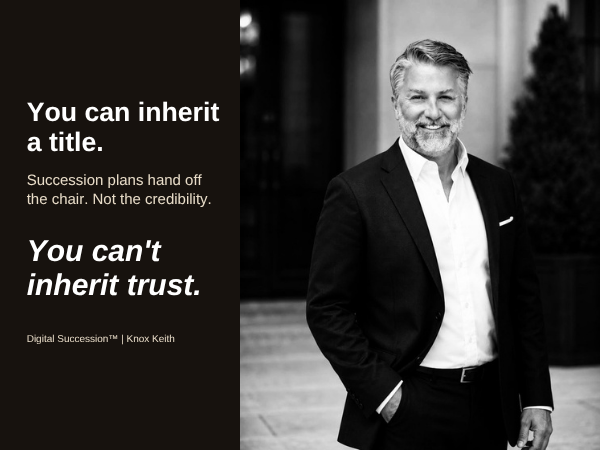
You Can Inherit a Title. You Can’t Inherit Trust.
I once worked with an SVP of Sales who had just been moved from leading one product line to leading another. Let’s call them Product A and Product B. The announcement had gone out that week, and he had every reason to be proud of it. When I ran into him in the break room, I asked him a simple question: “How are you going to let the market know you’ve moved to Product B?”
He looked at me for a second and said, “I hadn’t thought about it.”
That’s not a knock on him. He was a smart, accomplished sales leader with a track record anyone would envy. Nobody had ever asked him that question though. The company had planned and announced the move. Nobody had planned how the people outside the building would find out about it, or why they should care.
Succession Plans Hand Off the Chair. Who Hands Off the Credibility?
Most organizations take succession planning seriously. Boards assess candidates. HR builds readiness profiles. High-potential leaders get stretch assignments, coaching and executive education. By the time someone steps into a bigger role, the company knows they’re ready.
But the outside world doesn’t. That gap is what I call a digital succession problem: the handoff of credibility, visibility and trust from one leader to the next, in the places customers, investors, candidates and partners actually go to check. Succession planning hands off the chair. Digital succession hands off the reason anyone outside the company should believe in the person. Most companies have a plan for the first. Very few have a plan for the second.
Search for a newly named CEO the week of the announcement and you can see it happen. The predecessor’s interviews still rank. Their LinkedIn profile may still say CEO. The search results belong to the person who left, while the new leader shows up with a profile last touched years ago and a three-paragraph bio on the corporate site. The org chart changed. The internet didn’t get the memo.
A Press Release Is a Declaration
When a leader changes roles, the default communication plan is a press release and maybe a post on the company page. It feels like enough. It isn’t. A press release is finished the moment it goes out. Nothing keeps it in anyone’s feed and nothing keeps it relevant. It announces that something happened. It doesn’t give anyone a reason to believe it matters.
That’s the difference between declaration and demonstration. The release declares that someone is the new leader. Customers, partners and prospects are looking for demonstration: evidence that this person knows their stuff, understands the market and is worth a meeting.
The press release is a declaration. The market is looking for a demonstration.
Back to the break room. After he admitted he hadn’t thought about it, we walked to his office and spent 45 minutes at the whiteboard. We sketched a pilot program built around him, his direct reports, his sales teams and the product managers for Product B. Instead of a single announcement, we built a well-orchestrated campaign™ that ran for twelve weeks. It positioned him as someone who knew the space, shared information his market actually found useful, and coordinated with internal teams to put marketing materials the company already had to work.
Six weeks into the pilot, he got a cold call from a former client. That client bought Product B, a $5 million deal, in four weeks. The standard sales cycle was 18 months.
I’m not going to pretend every executive gets a $5 million phone call six weeks in. But I can tell you what didn’t produce that call. The press release.
This Doesn’t Stop at the C-Suite
CEO transitions get the headlines, but leadership moves happen across an organization every week. A new VP of Sales inherits the company’s biggest accounts. A division president takes over a business whose partners have never heard of her. A top regional leader gets promoted into his first enterprise role.
Each move creates the same moment. People outside the company start evaluating someone they don’t know, and they usually start by searching. If what they find doesn’t back up the company’s confidence, the new leader starts from behind. In sales, that matters more than anywhere. The relationships a predecessor built don’t transfer automatically, and a competitor with a visible, credible rep on that account isn’t going to wait politely while your new leader earns trust one meeting at a time.
Here’s the part that bothers me. Companies invest real money developing these leaders: assessments, coaching, mentoring, executive education. Yet, they spend almost nothing making sure a customer can find out why those leaders were promoted. We prepare people for years to step into the role and leave the outside world to figure it out on its own.
Transitions Don’t Create the Problem. They Expose It.
The gap usually isn’t new. A high-potential leader can spend a decade doing excellent work entirely inside the company’s walls, and nobody notices the missing external footprint because nobody outside ever needed to look. Then a promotion, a retirement, an acquisition or a sudden departure changes that overnight.
Earlier this month I wrote that executive visibility is everybody’s problem and nobody’s job. Succession is where that gap gets expensive. Last week I wrote about what happens to visibility when people leave a company. This is the other side of the same coin: what happens when people move up. In both cases, the transition is the moment Executive Invisibility Risk™ stops being theoretical.
To be fair, a strong digital presence does not guarantee trust, and a quiet one doesn’t mean a leader lacks credibility. Plenty of exceptional executives built their reputations on relationships and results. But having a credible reputation and making it discoverable are two different things. If the evidence only exists inside the company, the people outside it cannot validate it.
Four Questions Worth Asking Before the Next Announcement
- Does our succession planning include external credibility? We assess whether a leader is ready to perform. Do we assess whether customers, investors and candidates can see why? [This must go beyond a one-time press release and an update to the company website.]
- What happens to customer trust when sales leadership changes? Is the incoming leader building credibility before inheriting the accounts, or after?
- Are our high-potential leaders building reputations beyond our walls? Or are we developing leaders nobody outside the company has heard of?
- If we announced a leadership change tomorrow, what would people find? Would the search results support the press release, or contradict it?
The Question I’m Asking CHROs and Sales Leaders
I’m having 30 conversations with Chief Human Resources Officers, Chief People Officers and sales leaders before Thanksgiving as research for my next book. The question I keep coming back to is simple:
When you promote someone into a leadership role, does anyone plan how the outside world will find out why?
If you’re a CHRO, CPO, CRO or sales leader, I’d like to hear how your organization handles it. Share your take in the comments, or message me on LinkedIn and let’s set up a conversation.
Because the day a leadership change is announced shouldn’t be the first day the market discovers who the new leader is.
You can inherit a title. You cannot inherit trust.

Knox Keith is the creator of Digital Validation® and the author of Validated: Add Value. Build Trust. Be Seen. He is an Emmy Award-winning storyteller, executive advisor, and adjunct professor at SMU’s Cox School of Business, working with organizations including Dell, AT&T, Nike, Chevron, and BP.
And as always —

➡️ Get Validated: Add Value. Build Trust. Be Seen. https://www.amazon.com/dp/B0GQ57HLXM

➡️ Join the Digital Validation™ program — https://knoxkeith.com/courses/
➡️ Give me a follow on LinkedIn: www.linkedin.com/in/knoxkeith
➡️ Subscribe to my newsletter: https://validatedbyknox.mykajabi.com/newsletter
Frequently Asked Questions
What is digital succession?
Digital succession is the handoff of external credibility from one leader to the next during a leadership transition. Traditional succession planning prepares a leader to perform the role. Digital succession makes sure customers, investors, candidates and partners can find and validate that leader’s expertise when they search for them.
How is digital succession different from succession planning?
Succession planning focuses on internal readiness: competencies, performance and the confidence of the board and leadership team. Digital succession focuses on external credibility: whether the people outside the organization can recognize why the new leader was chosen. Both matter when a leadership change becomes public.
Why isn’t a press release enough to announce a new leader?
A press release has a very short shelf life. It announces a change, but nothing keeps it in anyone’s feed or gives stakeholders evidence of the new leader’s expertise. A sustained, coordinated effort over weeks does far more to establish credibility than a single announcement.
What is a well-orchestrated campaign™?
A well-orchestrated campaign™ is a coordinated effort over an extended period that positions a leader as credible in their market. It involves the leader, their team and related internal groups, shares genuinely useful information, and often puts existing marketing materials to work, rather than relying on one post or announcement.
What is Executive Invisibility Risk™?
Executive Invisibility Risk™ is the organizational risk created when a company’s leaders cannot be easily found, understood or validated online by the people evaluating them. Leadership transitions are one of the moments when that risk becomes most visible.
Does this mean executives need to post on LinkedIn every day?
No. Digital succession isn’t about becoming an influencer or chasing followers. It’s about making sure credible evidence of a leader’s expertise, accomplishments and judgment exists where stakeholders look.
Who should own digital succession?
In most organizations, it crosses HR, Communications, Marketing, Sales and the executive, and nobody owns the whole thing. That ownership gap is explored in Executive Visibility Is Everybody’s Problem. And Nobody’s Job.