
(Part 1)
The Art of Creating Memorable Connections
Imagine an invitation to an intimate dinner party in Austin. Not another networking mixer where you balance a cocktail and a plate of appetizers while trying to remember someone’s name. A proper, grown-up dinner party.
You know who’s hosting, what to wear, and what to expect. The host has already called you personally with three questions. Do you have any dietary restrictions? What’s exciting you in life right now? And the one you didn’t see coming: what’s an album you love? You are intrigued!
When you arrive, someone hands you a glass of champagne. Music fills the room. The aroma of dinner drifts in from the kitchen, and fresh flowers and warm light do the rest. Around you are people from different backgrounds, most of whom have yet to discover what they have in common.
Here’s what stays with you. You felt welcome before you ever walked through the door. There was no confusion about where to go, what to wear, or whether you’d fit in. Someone had thought about those things for you. Someone had thought about you.
Welcome to Chateau Chloe.
The Woman Behind the Experience
I wasn’t at that particular dinner party. My friend Chloe Chiang described it to me during an interview, and the more she explained, the more fascinated I became.
Chloe isn’t just throwing beautiful parties. She is thinking hard about how experiences become memories, how memories create emotional connection, and how that connection grows into real relationships. She calls it Curated Serendipity™. I think she’s onto something.
What’s Your Favorite Album?
Let’s go back to that question. Not your favorite band. Not what you’re streaming this week. An album that means something to you.
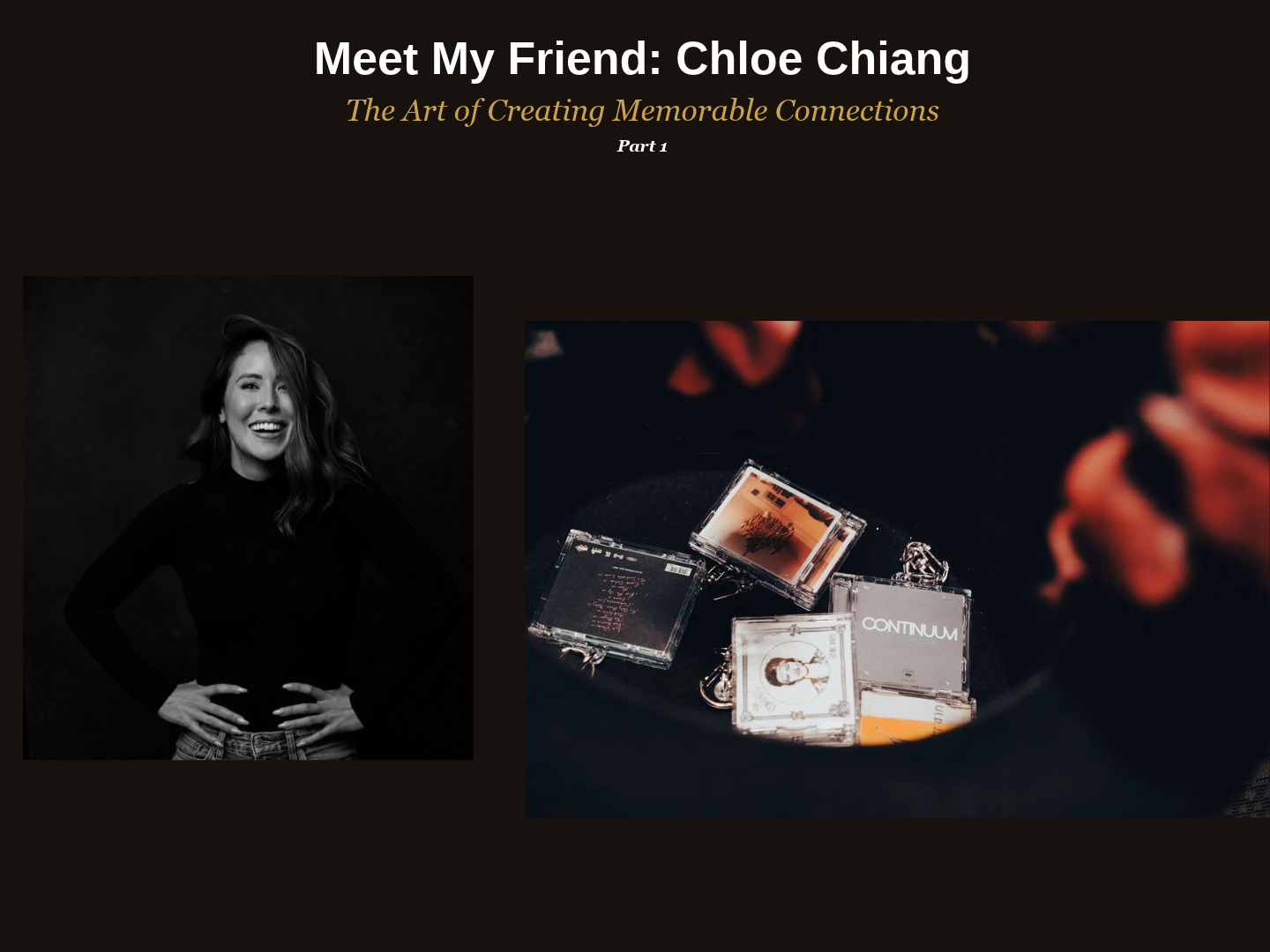
After the phone calls, Chloe commissioned miniature replicas of each guest’s album and placed one at every seat. Each held a tiny CD and a link that opened the music on Spotify. One guest chose The Beatles. Another chose Raekwon. That’s quite a range for one dinner table.
The brilliance wasn’t in the albums. It was in the stories behind them. Music can carry you back to your first car, a college apartment, a high school romance, or a summer you haven’t thought about in decades. You remember where you were, who you were with, and how you felt. Suddenly the conversation isn’t about what someone does for a living. Instead, it’s about who they are.
Chloe didn’t leave the rest to chance. She built the seating chart around what guests told her on those calls. During cocktail hour, she might lean in and mention that the woman standing next to you just got back from Spain, knowing that you were planning to go there on your summer vacation. Put the right two people together and provide the spark helps great relationships to start forming without a customer relationship management system anywhere in the picture.
She also knew the miniature albums gave guests something to hold, turn over, and talk about. It’s a small detail, and it makes an unfamiliar room feel a little more like home. Which raises a question.
What if we spent as much time thinking about how people will feel at our events as we do thinking about what we serve them?
How I Met Chloe
I met Chloe at South by Southwest this year through our mutual friend Amanda Russell, author of The Influencer Code. We connected, traded a few messages, and promised to get together. Then life happened. Months passed before we finally sat down for tacos in Austin.
I expected a pleasant catch-up. What I got was a flood of ideas about hospitality, human behavior, and the art of bringing people together. I kept asking questions, and Chloe kept peeling back another layer of what she was building. Somewhere in the middle, I realized we had the makings of a case study. Not about real estate. Not about event planning. But about something that gets harder to cultivate given how distracted we’ve become – always tied to our phones. (The irony of always being connected making us feel disconnected!)
Genuine human connection.
Chloe has spent 20 years building relationships in Austin, mostly through real estate. Along the way, she learned that getting someone a great deal isn’t enough. If clients do not enjoy working with you, they won’t send their friends your way. “It’s not even just about what I do,” she told me. “It’s how I do it.”
That philosophy shaped Chateau Chloe, the East Austin home she built as both her residence and gathering place. Inspired by the warmth, character, and sensory richness of New Orleans, the house was designed to be experienced, not just admired. And, through No Bad Company, the community she co-founded, Chloe is taking that philosophy to a wider circle.
The Five Senses and the Sixth Ingredient
Think about your most memorable experiences. A particular song. The smell of your grandmother’s kitchen. The sound of waves on a beach. The taste of a favorite meal. Our memories live in our senses, and Chloe understands that instinctively. Lighting, music, food, flowers, and texture all get her attention.
But there’s a sixth ingredient that may matter more than all of them.
The feeling of being seen.
Chloe kept coming back to it during our interview. People want to feel seen, heard, and understood, and for Chloe that shows up in small gestures. Friends who eat gluten-free arrived to find their names written on the gluten-free pizza boxes. A poker player who loves Japanese whisky found a bottle waiting for him. None of it is complicated, Chloe told me. It just takes paying attention.
She also asks guests to put their phones away. Not because technology is bad, but because it’s hard to be present when you’re checking what’s happening somewhere else. Chloe hires photographers so guests don’t feel obligated to document the evening themselves. At one party, she looked around and realized not a single person had a phone out.
I felt something similar on a two-week trip to Scotland with my son. My phone spent 14 days in airplane mode. Instead of reaching for it every time we stood in line, I talked with my son, asked questions of shopkeepers and distillers, and paid attention to the people and places around us. Sometimes the most memorable moments happen when we stop documenting our lives and simply live them.
The Return on Relationship
All of this reminded me of another friend, marketing strategist and author Ted Rubin. I’ve known Ted for nearly a decade, and what I’ve always admired about his thinking is that it starts and ends with relationships. Since 2009, he has championed a concept he calls Return on Relationship, or ROR.
Ted pushes back on the habit of judging every interaction by its immediate financial return. Relationships carry value that never shows up on a spreadsheet. Trust. Loyalty. Friendship. Recommendations. The willingness to help someone simply because you care about them. Ted likes to say that conversation is the best content. He also compares relationships to muscle tissue. The more you engage them, the stronger they get.
That’s the part we forget. Relationships aren’t something we acquire. They Are something we nurture, and they take attention, consistency, generosity, and time.
That’s where Chloe’s approach gets interesting. She isn’t just gathering people in a room. She invests in the experience before anyone arrives, creates openings for connection during the evening, and sends guests home with memories they carry long after the candles burn out.
Ted reminds us why relationships matter. Chloe creates environments where those relationships have an opportunity to begin.
Not through forced networking exercises or awkward icebreakers. Through experiences people remember.
Play. Connection. Strategy.
Chloe describes three layers to her dinners.
Play. Connection. Strategy.
Play creates a space where people relax, enjoy themselves, and experience something different. Connection happens when people start sharing stories, finding common ground, and building trust. Strategy is the thinking behind who’s in the room and what might grow from bringing them together.
That last layer is the one I appreciate most, because there’s a difference between creating the conditions for connection and trying to control the outcome. You can choose the guests. You can create a beautiful environment. You can introduce two people who might genuinely enjoy knowing each other. But you can’t manufacture a friendship. You can’t force trust. And you certainly can’t predict which conversation will change someone’s life.
Chloe’s intention is to create those openings without making the experience feel transactional. That’s a lesson for anyone who brings people together.
What Businesses Can Learn
I’ve spent three decades helping organizations like Dell and AT&T improve marketing, communication, and business performance. I’ve attended more corporate events, conferences, and networking receptions than I care to remember. Some were spectacular productions. Others I forgot before I reached the parking lot. The ones that stayed with me had one thing in common. Someone made me feel that my presence mattered.
It has never been easier to get someone’s attention, or harder to build a relationship that lasts. We spend enormous amounts of money capturing attention. We measure impressions, clicks, registrations, attendance, and leads. But how often do we ask whether the people at our events actually felt connected? Did they have a meaningful conversation? Did they leave with a memory worth sharing? Did the relationship outlast the event?
Here’s a harder question.
Are we confusing being noticed with being remembered?
A clever ad might hold our attention for a few seconds. A provocative post might gain thousands of reactions. Neither one builds trust, loyalty, or a lasting relationship. Chloe’s approach points somewhere else.
Attention makes you visible. Experiences make you memorable. Relationships keep you relevant.
That last line is the one businesses should sit with. Visibility is only the beginning. The real work is becoming someone people remember, trust, and want to stay connected with.
The lesson isn’t that every business needs to host an elaborate dinner party. It’s that we need to be more intentional about the experiences we create for other people. Sometimes that means a beautiful venue, a talented chef, and live music. Sometimes it means remembering someone’s name, asking a better question, or introducing two people who should know each other. And sometimes it means handing someone a miniature copy of their favorite album.
One Conversation Can Change Your Life
No Bad Company is built on a belief I love.
One conversation can change your life.
Think about the relationships that have shaped yours. How many began with an unexpected introduction, a chance meeting, or a conversation you almost didn’t have?
I met Chloe because Amanda introduced us at South by Southwest. Months later, we finally had tacos. That conversation led to this interview, several introductions within my own network, and an invitation to one of her upcoming dinner parties. None of it was planned. It happened because we took the time to connect, and that’s exactly the point.
We can’t predict where a relationship will lead. But we can be more intentional about creating room for real connection. We can spend a little less time collecting contacts and a little more time getting to know the people behind them. In the end, the most valuable thing you take from an experience may not be what you learned, what you bought, or even what you accomplished.
It might be how someone made you feel.
And that’s a memory worth creating.
But Chloe Left Me With Another Question
If meaningful experiences create lasting memories, and those memories build trust and relationships, what does that mean for businesses fighting for attention in an increasingly noisy world? What if the people who matter most to a brand are not the ones with the biggest followings, but the ones who have earned the trust of their communities? And what happens when we start measuring influence not by how many people someone can reach, but by how deeply they can connect?
Those are the questions we’ll take on in Part 2.
Meet My Friend is a series about interesting people, the ideas they’re exploring, and the lessons we can learn from them.
Learn more about Chloe Chiang and Chateau Chloe at chloechiang.com.

Knox Keith is the creator of Digital Validation® and the author of Validated: Add Value. Build Trust. Be Seen. He is an Emmy Award-winning storyteller, executive advisor, and adjunct professor at SMU’s Cox School of Business, working with organizations including Dell, AT&T, Nike, Chevron, and BP.
And as always —

➡️ Get Validated: Add Value. Build Trust. Be Seen. https://www.amazon.com/dp/B0GQ57HLXM

➡️ Join the Digital Validation™ program — https://knoxkeith.com/courses/
➡️ Give me a follow on LinkedIn: www.linkedin.com/in/knoxkeith
➡️ Subscribe to my newsletter: https://validatedbyknox.mykajabi.com/newsletter
Frequently Asked Questions
Who is Chloe Chiang?
Chloe Chiang is an Austin real estate professional and host who has spent 20 years building relationships in the city. She co-founded No Bad Company and hosts curated gatherings at Chateau Chloe, her home in East Austin.
What is curated serendipity?
Curated serendipity is Chloe’s term for designing the conditions for meaningful connection without forcing the outcome. She chooses guests with care, seats them thoughtfully and removes friction, then lets the conversations happen on their own.
What is the favorite album icebreaker?
Before a dinner, the host asks each guest to name an album they love, then places a miniature replica of it at their seat. It gives guests something to hold and talk about, and it moves the conversation from what people do to who they are.
What is Return on Relationship?
Return on Relationship (ROR) is a philosophy Ted Rubin has championed since 2009. It holds that relationships create value that never shows up on a spreadsheet, including trust, loyalty, recommendations and goodwill, and that they get stronger the more you engage them.
How can businesses create more memorable experiences?
Be intentional about how people feel, not just what you serve. Remember names, ask better questions, introduce people who should know each other, and give guests a reason to put their phones away. The goal isn’t to be noticed. It’s to be remembered.