
A few friends and I have a running bet. Every time one of us accepts a LinkedIn connection request from someone with “Helping People Do X…” in their headline, we start a stopwatch.
We call it TTP. Time To Pitch.
Five minutes? Ten? Fifteen if they’re playing it cool? We’re not kidding around — we’re betting tacos on this. Nine times out of ten, somebody’s collecting by lunch.
I accepted a connection request recently. Three minutes later: “Thanks for connecting! I’d love to share how we help companies like yours…”
Buddy. Slow down. We just met.
You don’t know me. You don’t know my business. You don’t know my priorities. You don’t know what’s keeping me up at 2:00 AM. You don’t know whether I already have a solution, or whether I even have the problem you’re trying to solve. Yet somehow, your strategy is to interrupt my schedule and add more noise to a life that already has plenty of it. That’s not a strategy. That’s a script running on a timer.
You aren’t helping. You are disrupting.
Let’s use an analogy that probably shouldn’t work for a business blog, but does: this is dating. Awareness is not consent. I just found out you exist — that’s all that’s happened. We haven’t even had a conversation yet, and you’re already trying to move to second base. Slow down. I’m not that easy, and neither is my business.
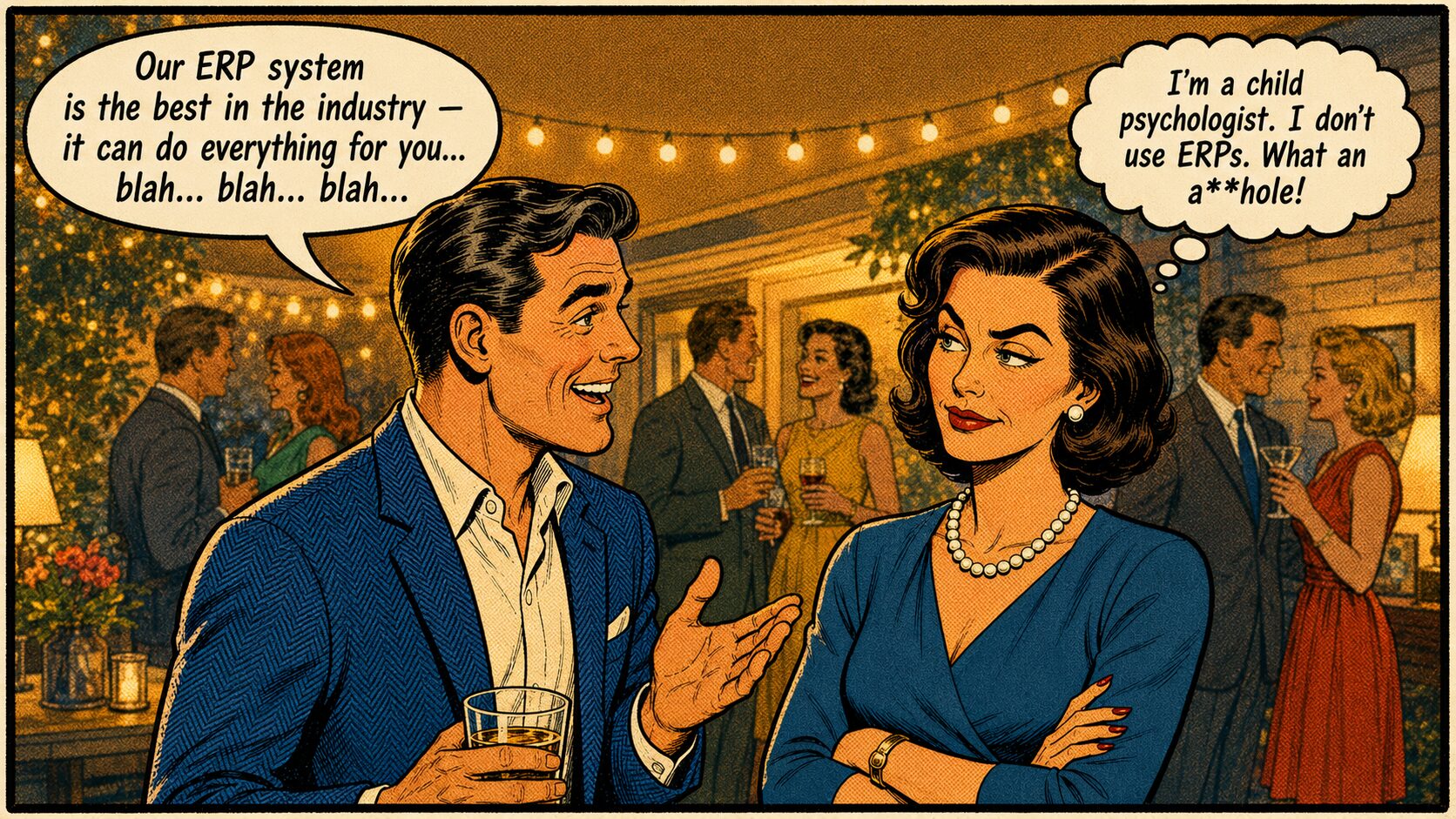
If that one’s too much, here’s a version everyone from CHROs to CROs will nod along to: imagine you’re at a dinner party. You shake someone’s hand. “Hi, I’m Steve.” Do you immediately start selling him something? No. You listen. You observe. You get a read on who these people are before you decide what, if anything, they need from you. Sure, someone might ask what you do for a living — that’s normal, that’s conversation. But that question isn’t an invitation to pull out your pitch deck between the salad course and the entree. Don’t be that a**hole.
Or try it this way: accepting a connection request isn’t a marriage proposal. It’s not even a first date. It’s basically eye contact across the room. And somehow, some people interpret that as “You know what? I think we’re ready to discuss your software implementation roadmap.”
Slow down, a**hole. Buy me tacos first.
Here’s the problem underneath the joke. Too many people confuse awareness with permission. I know you exist — that’s all. You haven’t earned consideration, and you certainly haven’t earned trust. Trust is where business actually happens.
My sales funnel has always been simple: Awareness → Consideration → Purchase. Too many salespeople — and too many of the CGOs and CROs who train them — are running Awareness → PITCH!!! That’s not a funnel. That’s a down right AMBUSH!
And here’s the part that should actually scare the “helping” crowd: this isn’t just annoying, it’s strategically self-defeating. Every unsolicited pitch that lands in someone’s inbox in under fifteen minutes tells that person exactly what kind of “help” is being offered — NONE. You’ve told on yourself: you’ve just said that you don’t want to help me. You want to hit a number, and I was just the next name on the list. Congratulations — you didn’t build a relationship. You became spam with a smiling profile picture.
The best salespeople I’ve ever known do something radically different. They get curious. They ask questions. They observe. They build reputations before they build pipelines. They court the relationship — genuinely, patiently — before they ever try to close it. They’re playing the long game, because they know something the TTP crowd doesn’t.
What They’re Actually Doing: Strategic Effects
There’s a name for what separates these people from the TTP crowd. I call it Strategic Effects — a five-step framework I’ve used with clients for more than two decades, and it’s the exact opposite of firing off a pitch three minutes after a connection request.
- Observe. Gather the facts before you gather the courage to pitch. Who is this person? What do they actually do? What have they said, posted, or asked about lately?
- Orient. Put what you observed in context. Does this person’s business even have the problem you solve? Is this a relevant moment for them, or just a convenient one for you?
- Analyze. Find the actual pattern or leverage point. “They exist and have a LinkedIn profile” is not an insight. A shared connection, a recent post, a real overlap in priorities — that’s an insight.
- Act. Take an intentional, measurable step — a thoughtful comment, a genuine question, a piece of relevant value. Almost never a pitch in the first DM.
- Repeat. Learn from what landed, adjust, and keep showing up. Relationships aren’t a single transaction. They’re a rhythm.
Run TTP through Strategic Effects and the math is obvious: a three-minute pitch skipped straight to Act, with no Observe, no Orient, no Analyze underneath it. That’s not a strategy — it’s an a**hole move. So STOP doing it.
Relationships compound. Trust compounds. Credibility compounds. Reputations compound. Transactions don’t.
Good salespeople do not create noise. Instead, they create relevance. They don’t chase transactions — they build reputations. They understand sequence, because sequence matters: awareness first, then consideration, then trust, then conversation, then opportunity.
I’m a relationship guy. Always have been. Most of my business has come from relationships built over years — sometimes decades. Long-tail relationships, not short-tail transactions. I don’t need another person in my inbox asking for fifteen minutes of my time. I need people — and the sales leaders training them — who understand that trust takes time, that credibility has to be earned, and that helping someone often starts with listening. Not pitching.
Trust doesn’t work on a stopwatch. It’s not built in the DMs five minutes after a connection request. It’s built the boring way — over time, through relevance, through actually paying attention to who someone is before deciding what they need.
So here’s my challenge: next time you accept a “helping” connection, start your own stopwatch. See how long it takes. Screenshot it. Tag me. Let’s build a leaderboard of the worst offenders — and maybe, just maybe, enough public embarrassment will get a few of these people to actually slow down.
Because the fastest way to lose my business isn’t taking too long to ask for it. It’s asking before you’ve earned the right to.
So yes, my friends and I will keep playing TTP. Because if your sales message arrives before my coffee gets cold, if your automation sequence hits my inbox before you’ve spent thirty seconds learning who I am — then you aren’t helping. You’re interrupting. And you might just owe me tacos.

And as always —

_________________________________________________________________________________________________________________________________________________
Knox Keith is a strategic advisor, corporate and MBA-level instructor, Emmy-winning storyteller, and author of Validated: Add Value. Build Trust. Be Seen. He has spent 30+ years helping professionals and organizations build credibility, communicate with clarity, and show up with confidence in the modern digital world.
_________________________________________________________________________________________________________________________________________________
➡️ Get Validated: Add Value. Build Trust. Be Seen. — your roadmap out of the crisis: https://www.amazon.com/dp/B0GQ57HLXM

➡️ Join the Digital Validation™ program — https://knoxkeith.com/courses/
➡️ Give me a follow on LinkedIn: www.linkedin.com/in/knoxkeith
➡️ Subscribe to my newsletter: https://validatedbyknox.mykajabi.com/newsletter
_________________________________________________________________________________________________________________________________________________
FAQs
What does “TTP” mean?
TTP stands for Time To Pitch — a tongue-in-cheek metric for how quickly a new LinkedIn connection turns a request into a sales pitch. The shorter the TTP, the less that person has bothered to learn about you first.
Why do LinkedIn connection requests turn into pitches so fast?
Most outreach today is automated and sequence-driven. A connection request accepted often triggers a pre-written DM within minutes, regardless of whether the recipient actually fits the sender’s ideal customer profile. Speed is optimized for; relevance often isn’t.
What’s actually wrong with pitching immediately after connecting?
It skips the steps that earn the right to sell: observing who someone is, orienting to their actual situation, and analyzing whether there’s a real fit. A pitch without that groundwork isn’t a strategy — it signals that the sender cares more about volume than about the person on the other end.
What should salespeople do instead of pitching right away?
Slow down and build the relationship in sequence: awareness, then consideration, then trust, then conversation, then opportunity. In practice, that looks like commenting thoughtfully, asking real questions, and offering relevant value before ever mentioning a product or service.
What is the Strategic Effects framework?
Strategic Effects is a five-step framework — Observe, Orient, Analyze, Act, Repeat — that Knox Keith uses in his consulting work and in his book, Validated, to build knowledge, credibility, visibility, and results. Applied to sales outreach, it’s the disciplined alternative to a same-day pitch: gather facts, put them in context, find the real leverage point, take an intentional step, then learn and adjust.
Does this apply beyond sales teams?
Yes. While the examples here center on sales, CGOs, and CROs, the same discipline applies to CHROs, recruiters, business development, and anyone using LinkedIn to build professional relationships rather than harvest transactions.