
Every company manages cyber risk. Every company manages legal risk. Every company tracks financial risk down to the decimal point.
None of them are monitoring Executive Invisibility Risk™.
Here’s the shift that created it. Opportunity used to knock. A recruiter called. A buyer asked around. A board member made an introduction over dinner. Somebody vouched for you, in person, before you ever showed up.
That world is gone.
Today, opportunity searches. Before the meeting, before the offer, before the contract gets signed, someone types a name into Google, Gemini, Chat GPT or Claude. 8.5 billion name searches happen every single day on Google alone.
Your next client is doing it right now, before the RFP gets written, before any first introductory email gets sent. Call it what it actually is: a Qualified Vendor Analysis. Long before a deal ever becomes a Qualified Sales Lead in your pipeline, the buyer is already running an informal audit, and it’s not just on your product. It’s on your company, and on the specific humans they’d be trusting to deliver on the promise. Executives, company, products, sales teams. All four get searched before anyone picks up the phone.
Your next hire is running the same search. A candidate isn’t only deciding if they want the job. They are also evaluating who they’d be working for. What does this manager, director, VP, or executive actually prioritize? How do they think under pressure? What makes them tick? Fit matters as much on the way in as leadership credibility matters on the way out, and if the search comes back empty, the candidate fills the blank with guesswork. Guesswork rarely favors you. Guesswork is a risk.
What they find, in either case, decides what happens next.
The Cost of Coming Up Empty
When a search turns up with nothing, people do not simply conclude there’s nothing to find. Instead, they conclude that there is something to worry about.
I call that moment Digital Dis-Validation™. It’s the silence a buyer or a recruit runs into when they go looking for proof and find a blank profile, a stalled feed, or nothing at all. Silence does not read as humility. It reads as risk.
A VP of Sales I know lost a multi-million dollar contract this way. Not because his product was weak. Not because his pitch was off. But because, the potential client’s purchasing team searched him during their due diligence, found nothing, and flagged the absence itself as an operational concern. The executive had no visible track record. No digital footprint in the industry conversations. Just a gap where evidence should have been easily found.
The deal died in the silence. And that invisibility risk? Well, it cost his company millions of dollars.
This Was Never About Personal Branding
I want to be precise about what I’m describing, because the term “personal branding” gets thrown around until it means nothing. This isn’t that.
Personal branding is limited to attention or awareness. Top of funnel only. Executive Invisibility Risk™ is about being trusted at the exact moment someone is deciding whether to invest money in your company’s products and services. And it’s one that belongs in boardroom discussions. It’s not a Marketing problem. It’s not an HR problem. It’s a company-wide strategic problem.
In practice personal branding screams: look at me. I have followers. I’m important. Listen to what I say.
It’s the “tell” in show, don’t tell. Personal branding is rarely about substance. Mostly, it’s just more noise in an already noisy market.
Rarely does personal branding move anyone from Awareness into Consideration, and that’s exactly where it fails. Getting noticed is not the same as being trusted. A buyer can know your name and still search you and find nothing that answers the only question that matters: can I rely on this person?
Professional branding, on the other hand, is different. It is designed to create signal, not add to the noise. It shows people that you know your business, because you consistently show up adding value without asking for anything in return. And that is what actually moves someone from Awareness to Consideration. It is the part personal branding was never built to do.
That’s the real reframe here. Executive visibility isn’t an individual’s hobby or a marketing department’s side project. It’s an organizational exposure, sitting quietly on the balance sheet next to every other risk you already manage, just uninsured. That is the Executive Invisibility Risk™ in a nutshell.
The Fix Has a Name
I’ve spent the years building a framework for closing that gap. I named it Digital Validation®: the disciplined building of a strong, consistent and professional online presence that earns trust before anyone asks for it.
Digital Validation® is what happens when the search doesn’t come back empty. When the buyer finds a point of view instead of a blank profile. When someone in the purchasing cycle finds evidence of judgment and credibility instead of just a name with a job title. That’s the difference between a leadership bench that closes deals faster and one that quietly costs you every day nobody’s counting.
The next question is obvious: how invisible is your leadership team, right now, today? That’s measurable. I’ve built a way to score it, the Executive Invisibility Risk Index™, and I’ll walk through exactly how it works in the next piece in this series.
This is the opening piece in the Executive Invisibility Risk series, research I’m developing alongside my second book, on how visibility, trust, and risk intersect at the leadership level. If you are a CHRO, CPO, CGO, CRO, or SVP of Sales, this is written for you and the decisions you’re already making about your bench. Let’s connect on LinkedIn. I’ll be sharing the research as it develops, and I’d like you in the conversation.
And as always —

About Knox Keith
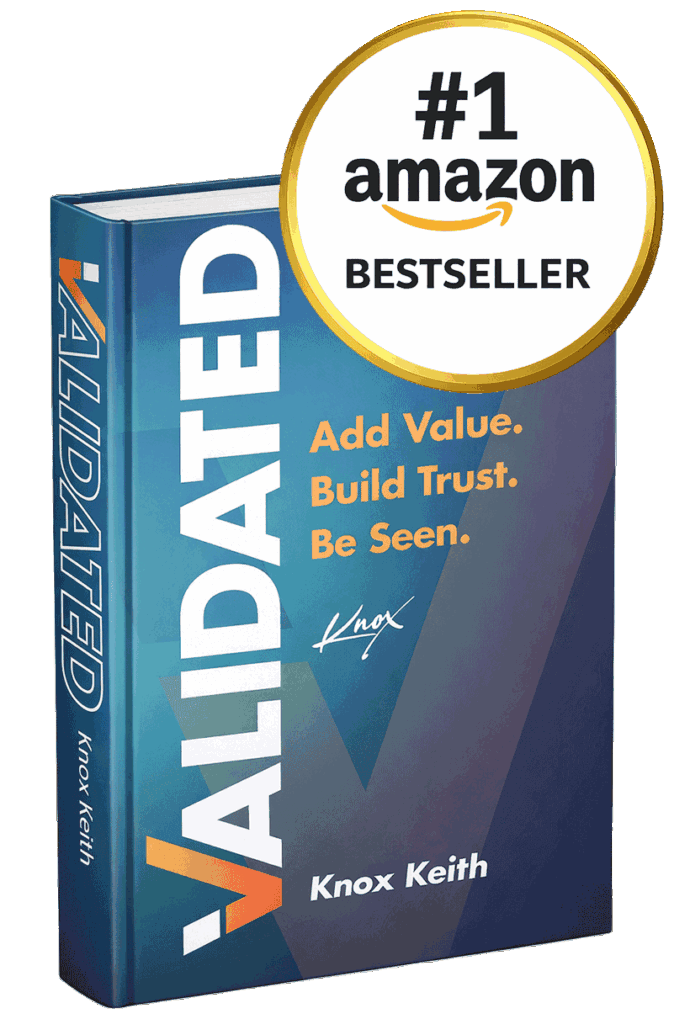
Knox Keith is a strategic advisor, corporate and MBA-level instructor, Emmy-winning storyteller, and author of Validated: Add Value. Build Trust. Be Seen. He has spent 30+ years helping professionals and organizations build credibility, communicate with clarity, and show up with confidence in the modern digital world.
➡️ Get Validated: Add Value. Build Trust. Be Seen. — your roadmap out of the crisis: https://www.amazon.com/dp/B0GQ57HLXM
➡️ Join the Digital Validation™ program — https://knoxkeith.com/courses/
➡️ Give me a follow on LinkedIn: www.linkedin.com/in/knoxkeith
➡️ Subscribe to my newsletter: https://validatedbyknox.mykajabi.com/newsletter
FAQ
What is Executive Invisibility Risk™?
It’s the organizational exposure created when leaders have little or no discoverable digital presence, causing buyers, recruits, and partners to infer risk from the absence of evidence.
What is Digital Dis-Validation™?
It’s the moment someone searches for a leader’s credibility and finds silence instead of proof, and reads that silence as a warning sign rather than neutral ground.
Is this the same as personal branding?
No. Personal branding optimizes for being liked. Executive Invisibility Risk™ is about whether a leader can be trusted at the moment a deal, hire, or board decision depends on it.
Who should care about this inside a company?
CHROs, CGOs, and CROs. It touches recruiting cost, deal velocity, and board and investor confidence, not just marketing metrics.