
Beyond the Algorithm
A few days after I sent my friend Chloe Chiang the first article in this series, she sent me a voice message. She loved the story: the dinner invitations, the miniature albums, the feeling of being seen before a guest ever entered Chateau Chloe.
But Chloe wasn’t ready to stop there. “If you’re visible today, how do you stay visible and relevant?” she asked. Then came the question that really got my attention: “If you take that noise out of the way, what is the actual signal?”
I’ve spent years working at the intersection of marketing, professional credibility, and trust. And the night before I began revisiting Chloe’s questions, my friend Amanda Russell had been exploring precisely this territory in her SMU class on influence architecture.
We’ve become so obsessed with being part of the conversation that we’ve forgotten to ask whether we’re contributing anything worth remembering.
Attention Is Not Influence
Amanda, author of The Influencer Code, offered a distinction worth remembering: attention means someone looked up. Influence means they acted. But between looking and acting lies something marketing too often skips: credibility.
Being noticed gives people the opportunity to learn about you. Credibility gives them a reason to take you seriously. Trust gives them confidence to make a decision. And influence is not simply the last-minute pitch; as Amanda put it, it is everything that makes the “yes” possible before you ask.
Popularity complicates the picture. Someone with 50,000 followers may have more than name recognition. There can be admiration, fascination, even a little awe. Those feelings are real. But being starstruck isn’t the same as trusting someone’s judgment. And reach alone cannot tell us whether anyone will act.
Visibility is the opportunity to be noticed. Credibility is the reason someone takes you seriously. Trust is what makes them willing to act.
The Sales Funnel Problem
In Validated, I use a familiar marketing funnel to illustrate the gap. Awareness is wide: lots of people may see your message. Consideration is narrower: fewer people decide whether you’re credible and relevant. At the bottom, fewer still make a decision.
Marketing often celebrates the top of that funnel — impressions, followers, views, reach. But awareness is only the opening. What moves someone from Awareness to Consideration, and from Consideration to a Decision (or Purchase)? It’s Credibility and trust.
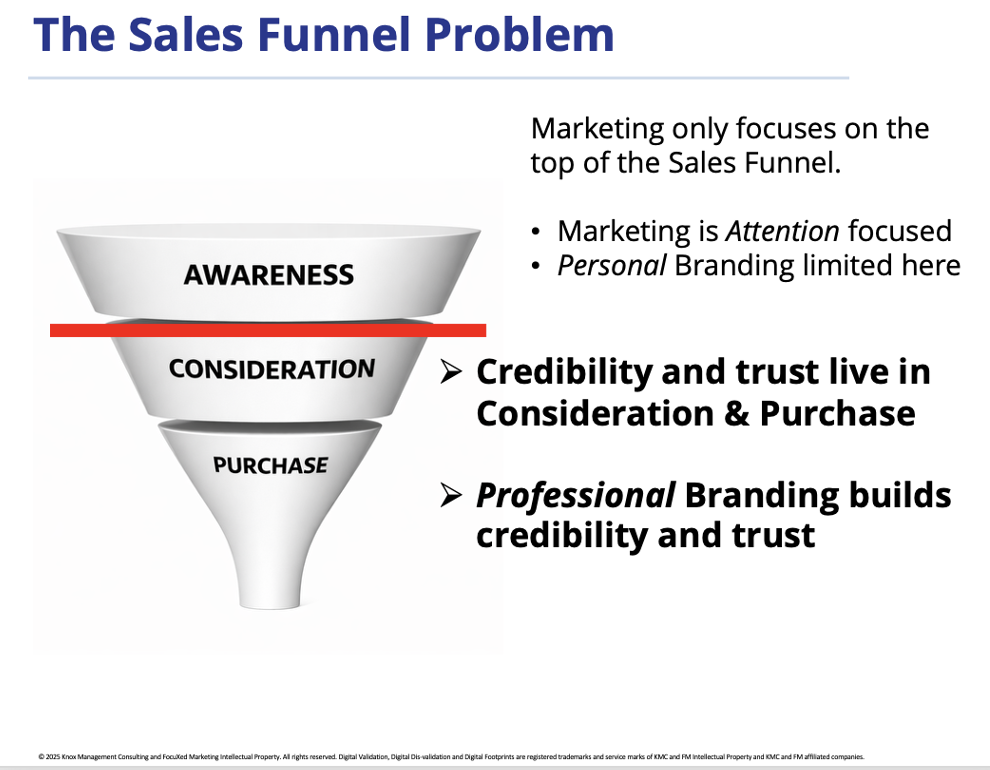
Sales funnel illustration from Validated: awareness alone does not create credibility or trust.
That’s why I distinguish personal branding, which only emphasizes getting noticed, from professional branding, which should give people reasons to believe in your expertise and judgment. A crowded top of funnel does not guarantee a meaningful relationship in the middle and the bottom.
The Person With the Most Followers May Not Be the Most Influential
Think of someone in your community who always knows whom you should meet. She remembers the contractor who did excellent work, the nonprofit that needs a volunteer, or the person who would genuinely enjoy hearing your idea. When she recommends someone, people listen — not because she has a massive audience, but because she has a history of paying attention and making good introductions.
Now imagine a creator with a vast following. That person may also be credible, and may influence decisions at enormous scale. The difference is not that digital influence is fake and real-world influence is authentic. It’s that reach and trusted judgment are different things, and one cannot stand in for the other.
Chloe wondered whether we’ve overlooked hosts, connectors, mentors, and community leaders simply because their influence is less visible on a dashboard. And that’s a question worth asking.
Chloe’s Biggest Competition Is the Sofa
Chloe told me something I haven’t stopped thinking about: her competition is the sofa.
Not another hostess. Not another event. The sofa.
After a long day, it’s tempting to stay home, binge-watch a show, or disappear into a scroll of other people’s lives. Sometimes that’s exactly what we need. This isn’t a complaint about technology — some of my best professional relationships began online.
But watching people live is not the same as participating in a life with them. The invitation requires a decision. Getting dressed. Leaving the house. Walking into a room where you might not know everyone. Being curious enough to start a conversation and present enough to hear the answer.
And connection doesn’t have to happen at a dinner party. It might be a walk, a call, a coffee, or a conversation that goes deeper than the usual “How are things?” The point is not physical presence at all costs. It’s active participation instead of passive familiarity.
Connection isn’t a single event. It’s an ongoing practice.
A Community Is More Than a Contact List
Somewhere along the way, “community” became a marketing buzzword. Every brand wanted one. We launched groups, collected email addresses, celebrated membership numbers, and sometimes called the resulting database a community.
But a mailing list is not a community. Neither is a room full of guests or a collection of phone numbers that eventually finds its way into another promotional campaign.
A community becomes meaningful when its members participate in one another’s lives: when they share useful ideas, make introductions, remember conversations, welcome newcomers, and notice when someone is missing. It needs care and continuity, not just a launch.
Chloe can create a beautiful evening. But the dinner is an invitation to connection, not proof that a community exists. The harder question is what happens the following Tuesday. Or three months later. Do guests reach out? Do they help each other? Do they become friends, collaborators, or trusted resources?
And the best communities don’t depend on the host making every introduction forever. Members begin connecting and helping one another. The relationships develop a life beyond the event.
Relationships Need Exercise
This is where my longtime friend Ted Rubin comes in. His Return on Relationship philosophy is about investing in people without treating every interaction like a transaction. Relationships don’t strengthen simply because we have someone’s contact information. They need attention, generosity, and repeated engagement.
Remember what someone told you about a child starting college. Ask how the job search turned out. Follow up on the project they were excited about. Introduce them to someone with whom they have something real in common. And sometimes pick up the phone rather than sending another quick text. Words matter, of course. But so do tone, timing, expression, eye contact, laughter, and the shared experience of being together. Email and text are useful tools; they simply don’t carry every dimension of human interaction.
One of the best connection strategies I know is surprisingly simple: be interested. Not interesting. Interested. It means listening below the surface, remembering what matters to someone, and following up when there’s nothing immediate to gain.
Ted helps explain why relationships must be nurtured. Chloe is creating opportunities for them to begin. The responsibility for keeping them alive belongs to all of us.
Are We Measuring the Wrong Things?
I understand why marketers measure impressions, attendance, clicks, and television ratings. Those numbers are accessible and useful. They tell us something about exposure. But exposure isn’t impact, and awareness isn’t trust.
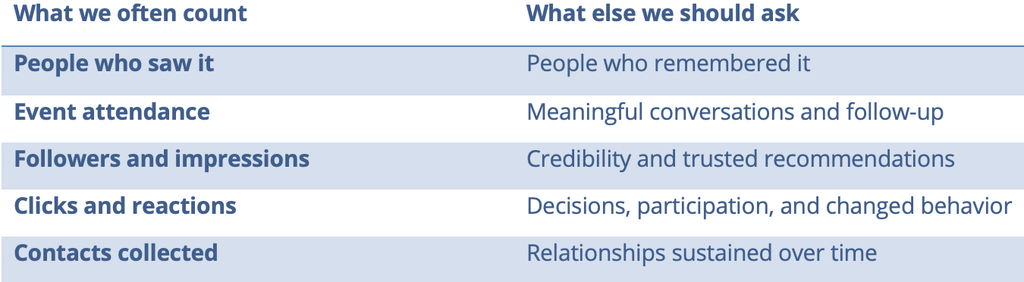
The second column is harder to measure, and not every friendship should become a metric. But if we claim we want influence, we should ask whether our efforts changed anything beyond the dashboard.
When Control Decreases, Trust Can Increase
My friend John Starkweather developed a “Progression to Trust” illustration that I included in Validated. Its insight is that messages an organization controls most tightly are not necessarily the messages people trust most.
A brand controls its advertisement. It has less control over an independent analyst’s assessment, a customer’s review, or a friend’s recommendation. Yet the credibility and trust of those voices can be greater precisely because they are not simply repeating the brand’s script.
That is not an iron law. A friend can be mistaken; an analyst can be wrong; a company can communicate truthfully. The point is that the source and the relationship change how we interpret the message. Trust is earned through experience and demonstrated judgment, not manufactured by tighter message control.
Think about the recommendation that matters most when you’re making an important decision. Often it comes from someone who knows you, understands what matters to you, and has earned the right to be believed.
The Signal Beneath the Noise
So what is the signal Chloe was asking about? I don’t think it’s another kind of influencer, a better event, or a cleverer way to generate attention. I think it’s the slow, unglamorous work of turning an introduction into a relationship.
Digital visibility matters. It helps us find people, understand their work, and stay connected across distance. But visibility was never the point. I wrote Validated because we’re living through a credibility crisis, where being seen is easy and being believed is hard. A digital presence is not a substitute for being known, and being known is not the same as being trusted.
So You Met Someone. Now What?
This is the heart of Chloe’s question. You met someone at a conference. Better yet, you sat next to them at a dinner party and talked about the album that got you through college. You traded numbers. You meant it when you said, “Let’s stay in touch.”
Then Monday happened.
Most relationships don’t end in conflict. They end in neglect. Nobody decides to let the connection go. We just never decide to keep it.
Chloe can set the table. She can seat you next to the right person and hand you a reason to talk. She create a unique and memorable experience. But what she cannot do is make the follow-up call for you. The dinner belongs to the host. The relationship belongs to the guests.
That’s the part no one can orchestrate. But it can be practiced. Building relationships is a skill, and like any skill, it gets stronger with repetition. That’s Ted’s muscle tissue. You don’t get strong from one heroic workout. You get strong by showing up consistently over time.
Why It Has to Be Human
Some of that practice has to happen in person, or at least out loud. Facts travel fine by email. A meeting time, a link, a contract term: text handles those well. Trust is different. Warmth, sincerity, and the sense that someone means what they say travel through tone, eye contact, expression, and the small pause before someone laughs. When the words and the tone disagree, we believe the tone. A text can’t carry that. A dinner table can. So can a phone call.
That’s why Chloe’s competition is the sofa and not another host. The sofa offers connection without effort and familiarity without presence. It feels close enough. It isn’t.
The Real Signal
Perhaps the question for organizations, and for the rest of us, isn’t only “How do we reach more people?” Instead, it includes “What are we doing to deserve their trust after they notice us?”
Chloe’s dinner guests might remember the music, the food, or the miniature album waiting at their seat. What matters next is whether someone remembers their story, follows up, and makes room for another conversation.
The real signal isn’t how many people saw you. It’s whether people know you, trust your judgment, and think of you when you’re not in the room.
Your Turn
So here’s a small assignment. Pick one person you’ve met in the last month. Follow up on something they told you: the kid starting college, the job search, the project they were excited about. And call instead of texting.
Then do one more thing. Think of the connector in your life, the person whose recommendation you’d trust without question. Tell them. Better yet, tag them on LinkedIn and tell the rest of us why.
Chloe would call that a good start. Ted would call it exercise.

Knox Keith is the creator of Digital Validation® and the author of Validated: Add Value. Build Trust. Be Seen. He is an Emmy Award-winning storyteller, executive advisor, and adjunct professor at SMU’s Cox School of Business, working with organizations including Dell, AT&T, Nike, Chevron, and BP.
And as always —

➡️ Get Validated: Add Value. Build Trust. Be Seen. https://www.amazon.com/dp/B0GQ57HLXM

➡️ Join the Digital Validation™ program — https://knoxkeith.com/courses/
➡️ Give me a follow on LinkedIn: www.linkedin.com/in/knoxkeith
➡️ Subscribe to my newsletter: https://validatedbyknox.mykajabi.com/newsletter
Frequently Asked Questions
What is the difference between attention and influence?
Attention means someone noticed you. Influence means they acted. Between the two sits credibility, the reason someone takes you seriously, and trust, which gives them the confidence to make a decision.
Why isn’t reach the same as influence?
A large following can create recognition and even admiration, but being starstruck isn’t the same as trusting someone’s judgment. Reach shows how many people saw you. It can’t tell you whether anyone will act.
What is the difference between personal branding and professional branding?
Personal branding focuses on getting noticed. Professional branding gives people reasons to believe in your expertise and judgment, which is what moves them from awareness to consideration to a decision.
How do you build a relationship after meeting someone at an event?
Follow up on something they told you. Make a useful introduction. Pick up the phone instead of sending another text. Relationships are a skill that gets stronger with practice, and the follow-up belongs to the guests, not the host.
Why does in-person connection still matter?
Facts travel well by email and text. Trust travels through tone, eye contact, expression and shared experience. When words and tone disagree, people believe the tone.