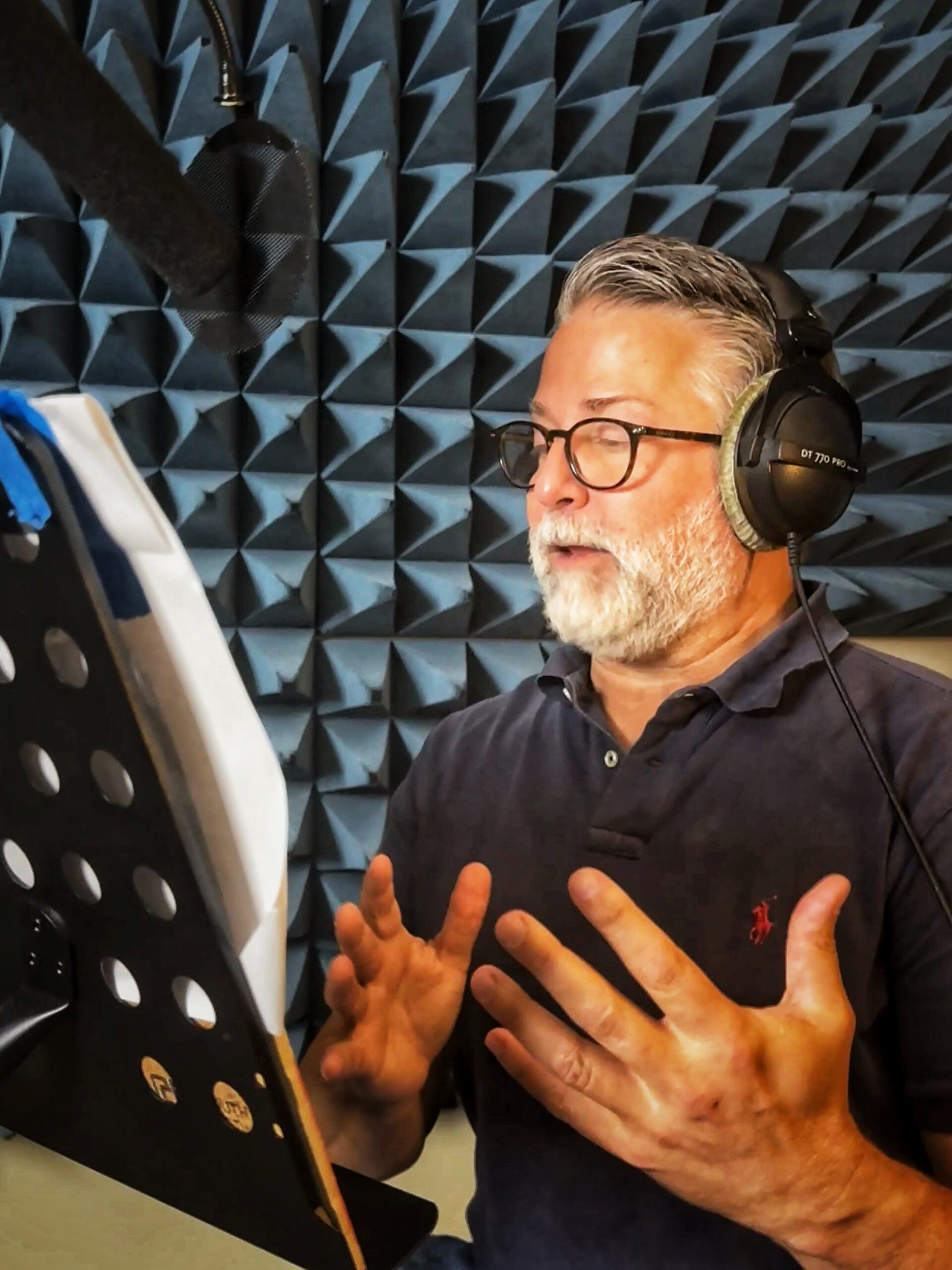
I spent six hours in a recording studio this week reading my book (Validated: Add Value. Build Trust. Be Seen.) out loud. That’s a lot of talking, even for me.
I’ve given speeches, taught classes and led workshops. I’ve facilitated executive meetings. Put me in front of a room with a PowerPoint deck and a subject I know, and I generally think I can knock it out of the park. But put me alone in a sound booth with a microphone and ask me to read words that I’ve already written, and apparently that’s a different thing entirely.
You hear everything in the sound booth. The words I don’t enunciate clearly enough. The breaths in the wrong places. The sentences I rush. The strange little sounds my mouth makes. The emphasis that sounded better in my head than it does out loud. And when I get tired, which happens after several hours of reading, I can hear my speech lose its crispness in real time.
The engineer working with me is good, and patient. He stops me. We do another take. Sometimes several. I’d also spent weeks prior with a voice coach before the recordings began, so I thought I was prepared. Maybe I was. But I wasn’t prepared for what it would feel like to actually hear myself.
There’s some history here.
When I was two years old, I suffered a traumatic head injury. As a result, I had a speech impediment. Speaking clearly wasn’t something I got for free — it was something I had to work at. “ta ta ta … TEE … du du du … DEE … pu pu pu … Puppy…” Over and over again. To this day I cannot hear the difference between T’s and P’s.
Which makes the trajectory of my life a little strange to look back on. I went to college and studied English literature. Words. My first desk job out of college involved sales, customer service, and eventually training. Communication. Then I went to business school. After my MBA, much of my professional life became about taking complicated things and explaining them to other people, and PowerPoint became one of my tools, along with conference rooms, workshops, classrooms, and stages.
Eventually I became a corporate instructor and then wrote a book: fifty-something thousand words about communication, credibility, trust, and visibility. And shortly after publishing it, I walked into a recording studio and sat down in front of a microphone.
There’s some irony in that. The kid who struggled to speak grew up and wrote a book about being heard, and then had to read the damn thing out loud.
I thought I had already overcome this.
That’s probably the part I’ve been sitting with. If you asked me whether I’m comfortable speaking, I’d say yes without hesitating. Give me an audience, give me a topic I know, give me a presentation, and I’m good.
But presenting gives me tools that narration doesn’t. I can look at someone. I can gesture. I can change the sentence mid-thought if it feels wrong. I can read the room and respond to its energy. And most importantly, I don’t have to listen to myself afterward.
The recording studio takes all of that away. The words are already written. The microphone is six inches from my face, and it hears everything. So do I. Maybe that’s why this touched something older than I expected. I’m not hearing my voice the way other people hear it — I’m listening for what’s wrong with it. And I realized this afternoon that there’s a difference.
A friend once told me she finds my voice soothing. I thought about that this week, sitting in the studio. Soothing? Really? Because that’s not what I’m hearing. I’m hearing imperfections. But maybe we’re listening for completely different things.
I hear the consonant I didn’t hit quite right. She hears and feels warmth.
I hear the breath. She hears calm.
I hear a sentence that could have been cleaner. She hears me.
That’s been an interesting realization.
Maybe this is Digital Validation® in a strangely literal form.
The premise of Validated is that people need to allow themselves to become truly seen — not for vanity’s sake, but so other human beings can actually connect with them. So they can establish credibility. Build trust. Be known for something.
I’ve spent years encouraging people to stop hiding behind corporate language and institutional identities and let more of themselves show up. And now here I am.
Here is my actual voice. Not a carefully edited LinkedIn post. Not the photograph I chose from fifty others. Not the professionally designed book cover. Not a paragraph I’ve rewritten seventeen times.
My voice. Breath. Cadence. Texas twang. Imperfections and all. Me.
That’s a little more vulnerable than I expected it to be.
I’m not sure there’s a lesson here.
I’m usually good at finding one — occupational hazard, probably. I’ve spent a career taking complicated things apart and trying to understand why they work the way they do, and most of my writing follows the same pattern: here’s something I noticed, here’s why it happens, here’s what it means, here’s what you should do about it.
But I don’t know that I have a “what you should do about it” for this one. Maybe I don’t need one.
Maybe this isn’t about overcoming a speech impediment. That would make a nice story: kid struggles with speech, kid works hard, kid grows up, kid becomes a professional communicator, kid writes and narrates a book. Roll credits.
Except that’s not quite what happened, because I can still hear traces of that kid. Maybe I always will. And maybe the point isn’t to completely erase him. Maybe the point is to stop requiring his absence as proof that I’ve succeeded. That’s different.
I’m going to keep working at the narration. I’ll redo the sentences that need redoing. The engineer will clean up what he can, and we’ll make the audiobook as good as we reasonably can. But I’m beginning to suspect that making it good and making that little kid with the speech impediment disappear from it are two very different objectives.
Maybe that’s the strange final lesson Validated had waiting for me after I’d already finished writing it.
I wrote a book about being seen.
Then I walked into a studio and discovered I had to be heard.
And this is what I sound like.