
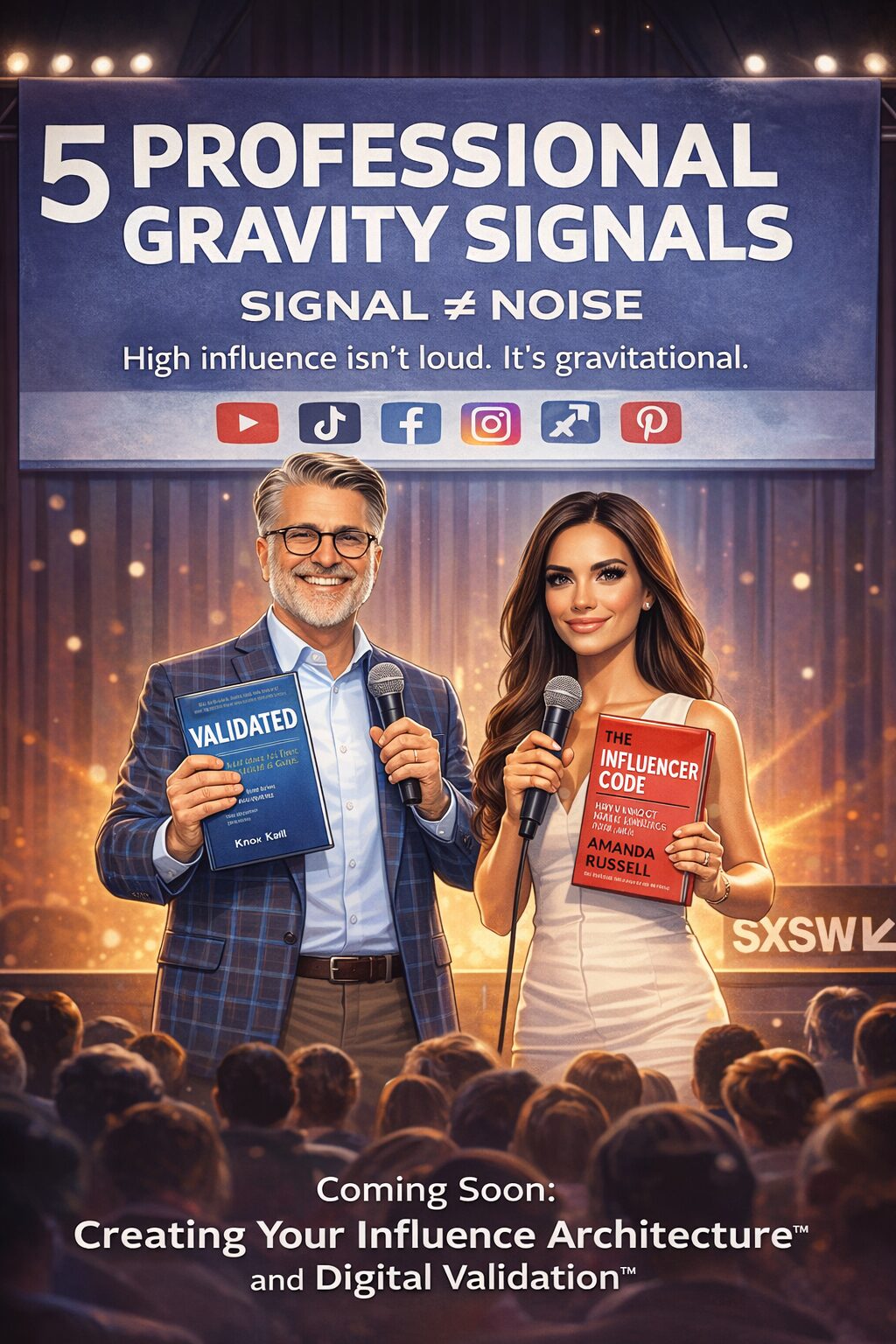
Why some professionals pull people in — and others just make noise
There’s no shortage of “visibility” right now.
Everyone is posting. Everyone has an opinion. Everyone is “building personal a brand.”
And yet, very few people actually have professional gravity.
You know these people. The ones who don’t have to chase. Or raise their voices. Or need to explain why they matter.
Their reputation does the work before they arrive.
That’s the difference between noise and signal.
High professional signal isn’t loud. It’s not viral. It’s not performative.
It’s gravitational.
Over the years — working with executives, founders, sales leaders, and senior operators — I’ve noticed the same patterns show up again and again. The people with real influence share a small set of traits that quietly separate them from the rest.
I call these the 5 Professional Gravity Signals.
1. Reputation Before Presence
High-signal professionals are known before they speak.
Their name travels ahead of them. Their work is referenced in rooms they’re not in.
They’re invited — not pitching themselves into conversations.
This doesn’t happen by accident.
It’s the result of:
- consistent value creation
- clear positioning
- and a track record others can point to
When someone says, “You should talk to them,” that’s gravity.
Signal shows up before you do.
2. Decision Authority
High signal is rooted in consequence.
People with gravity make real decisions:
- they own budgets
- they lead teams
- they’re accountable for outcomes
They don’t just comment on strategy — they live with the results of it.
This matters because:
- opinion without consequence is cheap
- commentary without responsibility is easy
- insight forged under pressure is rare
Authority isn’t about titles. It’s about responsibility.
3. Consistency Over Time
Noise spikes. Signal compounds.
High-gravity professionals aren’t reinventing themselves every six months. They don’t chase trends or pivot personalities. They show up with:
- consistent themes
- consistent values
- consistent standards
You may not notice them every day — but over time, trust accumulates.
Anyone can generate attention once. Very few people earn belief repeatedly.
Consistency is what turns visibility into credibility.
4. Peer Recognition
Gravity is confirmed sideways — not upward or downward.
High-signal professionals are:
- cited by peers
- invited by equals
- trusted by people who don’t need to flatter them
This is an important distinction.
Praise from an audience is nice. Respect from peers is proof.
When smart people reference your work without you in the room, that’s not marketing — that’s validation.
Who trusts you matters more than how many follow you.
5. Clarity of Thinking
High signal feels different.
It’s calm. It’s grounded. It’s precise.
People with gravity don’t rush to react. They don’t chase outrage or perform certainty. They:
- think clearly
- communicate cleanly
- and leave others feeling oriented, not overwhelmed
Noise accelerates chaos.
Signal creates coherence.
Clarity is the ultimate credibility cue.
Why This Matters Now
We’re living in an era that rewards volume — but trusts restraint.
That’s why:
- not everyone with reach has influence
- not everyone with a platform has gravity
- and not everyone who’s visible is actually seen
This is also why I’ve become less interested in attending big moments — and more interested in curating them.
Whether it’s SXSW, leadership workshops, or professional development, the real value isn’t in who shows up loudly.
It’s in who quietly pulls others toward them.
The Question Worth Asking
If you stripped away:
- frequency
- follower counts
- and surface-level engagement
Would your professional presence still hold weight?
That’s the work of Digital Validation. Not being louder — but being unmistakable.
Because in the end:
High signal isn’t about being everywhere. It’s about being undeniable.
>>>>
If this resonates, I’m exploring this concept more deeply — including how professionals can intentionally build these gravity signals over time through an Influence Architecture™ (by Amanda Russell) that includes these professional gravity signals and Digital Validation™.
DM me if you’re interested in learning more.
And as always —

➡️ Give me a follow on LinkedIn: www.linkedin.com/in/knoxkeith
➡️ Subscribe to my newsletter: https://validatedbyknox.mykajabi.com/newsletter