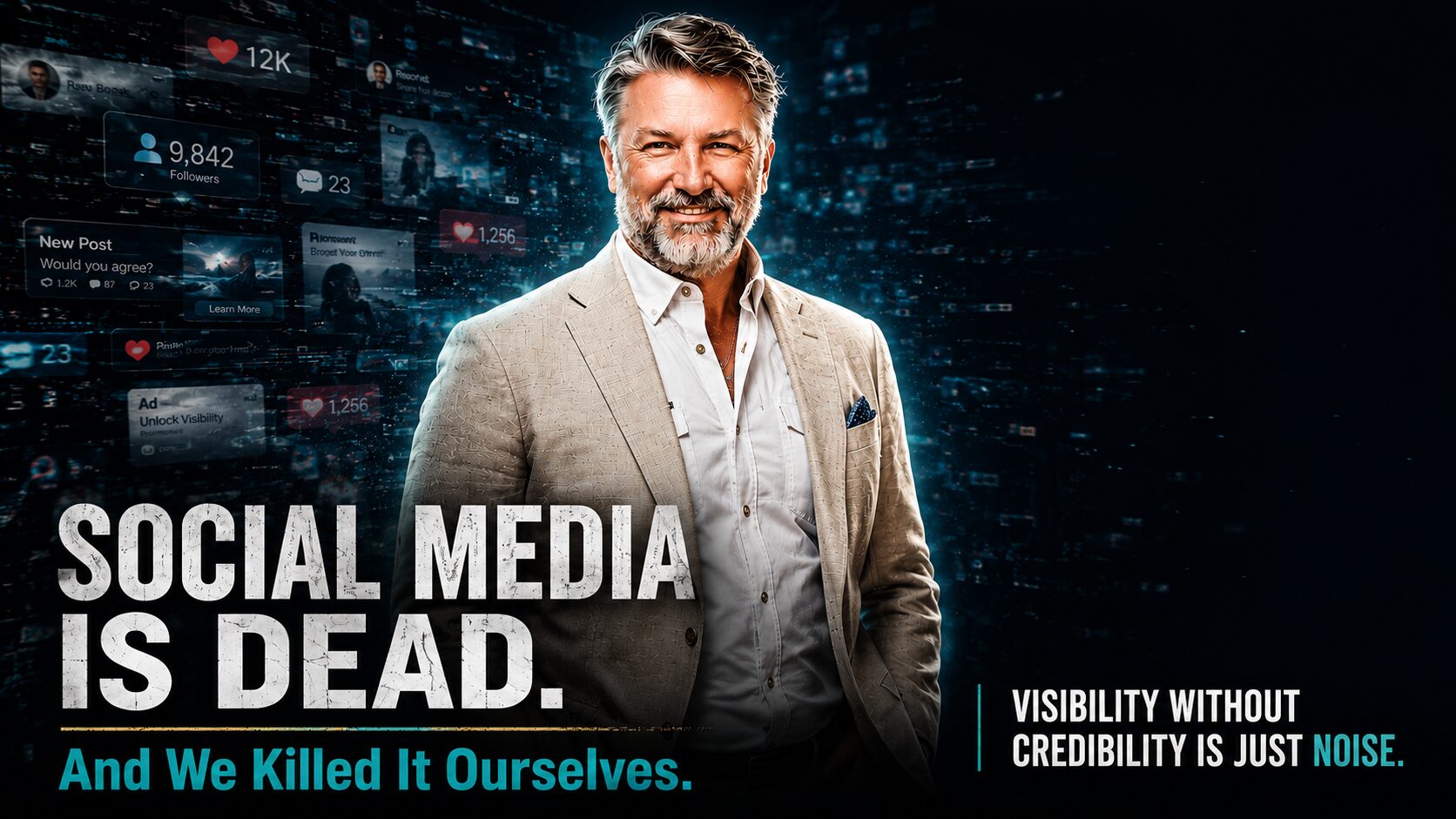
And I think we killed it ourselves.
I’ve been in and around social media since the early days. I’ve watched it grow from a digital watering hole where old friends reconnected into something that barely resembles what it started out to be.
So I’m going to say the quiet part out loud: Social media is dead.
What we have now? It’s something different. Something I’ve started calling interest media. And I’m finding less and less value in it every single day.
Let me explain.
Remember When It Was Actually Social?
Cast your mind back. Facebook launched in 2004. Twitter a couple of years later. LinkedIn had already been around since 2003. And for a while, it was genuinely exciting.
Social media was a way to connect. With old college friends. With people you met at conferences. With strangers who would become real relationships. Take my friend Anh Nguyen for example. We first met on a Google Hangout that I had grown to almost a million followers. We stayed in touch over the years, would meet up in person from time to time and are now working together twenty years later! And when you finally met one of your digital pen pals face-to-face, we called that #IRL. In Real Life. It was a thing.
The motto back then was simple: share good stuff.
Nobody was talking about “personal branding.” Nobody had a content calendar. Nobody was worried about posting cadence or optimizing for the algorithm. You just…shared. A funny photo. A milestone. A recommendation for a great restaurant. A memory. A laugh.
It was human. It was warm. It was social.
Then the Business Model Happened.
Remember the dot-com era? Pro formas built on fantasy. Projections that had no basis in reality. Investors got burned. Hard.
When the dust settled, one thing became very clear: you have to turn a profit. Eventually, the party has to pay for itself.
And for social media platforms, the answer was advertising. Targeted advertising. Sophisticated, data-rich, behavioral advertising. If the platforms could prove they knew you — your preferences, your habits, your purchase history — they could charge brands a premium to reach you.
So your feed stopped being about your people. It became about their revenue.
Here’s a personal example. I recently bought a pair of dime store reading glasses on Amazon. Paid maybe ten bucks. Nothing exciting. But now? Every ad I see on Facebook is about eyeglasses. Sunglasses. Readers. Blue-light blockers. Contact lenses. My entire ad experience has been hijacked by one unremarkable purchase.
I didn’t ask for that. Nobody does.
The Algorithm Ate My Friends.
Here’s the number that should stop you cold.
I have over 3,000 friends on Facebook. Out of those 3,000+ people, I regularly feel that I see only 15 to 20 different people in my feed. And most of them aren’t even the ones I actually care about. (Sorry / not sorry to my third-cousins twice removed.)
Think that’s just me? It’s not.
Facebook’s organic reach averaged just 1.37% in 2024. That means if you have 3,000 connections, the algorithm is actively showing your content to roughly 41 of them. Not because those 41 are your closest friends. Because the algorithm decided they were the most likely to engage in a way that benefits the platform.
I tried to fight back. I spent time training the algorithm. Only show me close friends. Only show me vacation pics, holiday photos, puppies and inspirational quotes. Only show me good stuff.
And for a while, it worked.
Now? It’s crap again.
And don’t even get me started on the desktop vs. mobile UX. They are not the same experience. Not even close. This old guy prefers doing most things on a full desktop — and Facebook clearly does not care about that anymore.
Then TikTok Showed Up and Changed Everything.
Here’s where things really shifted.
TikTok didn’t just compete with Facebook and Instagram. It exposed them. It showed the world what engagement could look like when a platform is ruthlessly optimized around interest rather than connection.
When I was writing my book, the average TikTok session was 55 minutes. Facebook and Instagram weren’t even close. That’s not a stat you ignore when you’re running a platform.
So the legacy players had to pivot. Facebook and Instagram became more like TikTok. Even LinkedIn has dabbled with short-form video. The pressure was real. The business imperative was clear.
But in doing so, they gave up the thing that made them valuable.
They traded connection for attention. And there’s a massive difference between the two.
Welcome to Interest Media.
What we have now isn’t social media. Not really. It’s interest media.
Your feed isn’t curated around your relationships anymore. It’s curated around your behavioral data. The algorithm doesn’t ask, “What does Knox want to see from the people he cares about?” It asks, “What content will keep Knox on the platform longest?”
Those are very different questions. And they lead to very different feeds.
More than half the content the average person sees on Facebook today comes from accounts they don’t even follow. That’s not a social network. That’s a content discovery engine with a social layer painted on top.
I’m not saying interest media is evil. If I want to find content about management consulting or employee advocacy or the Dallas Cowboys, the algorithm can surface it. Fine.
But that’s not why I signed up. And it’s not what most of us were promised.
The One Exception: LinkedIn.
Here’s where I’ll break from the funeral.
LinkedIn still works. For me. In my world. And I say that not as a LinkedIn fanboy — I say it as someone who has watched every other major platform lose the plot.
On LinkedIn, I can share. Comment. Engage. Learn. Connect with people doing genuinely interesting work. I can follow conversations that matter to my profession. I can reach decision-makers, thought leaders and people I actually want to meet.
That’s not interest media. That’s still, at its core, social — even if the social layer is professional rather than personal.
That said, LinkedIn isn’t perfect. The constant DMs from people I’ve never met trying to sell me things I’ve never asked about? That’s a daily nuisance.
Can you spell B-L-O-C-K?
But on balance? LinkedIn remains the one platform where I feel like I’m gaining something by showing up. And that’s worth saying out loud.
Signal vs. Noise: Why Employee Advocacy Has to Evolve.
Here’s where this gets personal for a lot of organizations.
For years, companies have invested in employee advocacy programs. The idea was simple and smart: empower your people to share company content on social channels, expand your organic reach and build brand credibility through trusted voices.
It worked. For a while.
But the platforms changed. And most advocacy programs didn’t.
When Facebook’s organic reach was meaningful, a team of 50 employees sharing a post could generate real visibility. Today? That same team of 50, sharing the same post, reaches a fraction of what it once did. The algorithm isn’t rewarding volume. It’s rewarding relevance. And relevance is built on individual credibility, not shared content.
Here’s the distinction that matters: there’s a difference between signal and noise.
Noise is your employees posting or re-posting branded content on platforms that bury it before anyone sees it. Signal is your employees showing up on LinkedIn with complete, credible profiles — commenting thoughtfully, sharing expertise, building the kind of professional presence and relationships that makes someone want to click through, reach out and potentially do business.
The shift from social media to interest media didn’t kill employee advocacy. It raised the bar for what advocacy actually means.
Your people are either building signal or generating noise. On most platforms today, it’s mostly noise. On LinkedIn — if it’s done right — it’s the most powerful signal your brand has.
That’s not a small distinction. It’s a strategic one.
What This Means for Leaders, Sales Teams, and HR.
If you’re a CHRO, a CGO, or a CRO, this isn’t just a personal rant from some guy who misses the old Facebook. This has real organizational implications.
For CHROs: Your employees are building — or not building — their professional presence on platforms that are increasingly optimized for distraction. When your team shows up on social channels, are they visible? Or are they invisible because the algorithm buried them? Employee advocacy programs built on the old “post and hope” model don’t work anymore. The platforms changed. Your strategy has to change with them. The new standard is credibility-first advocacy: are your employees findable, trustworthy and professionally visible on the platforms that actually matter?
For CGOs and Sales Leaders: Your sales team’s prospects are spending time on platforms that no longer surface organic professional content the way they once did. If your reps are relying on social selling through Facebook or Instagram, they’re working against the algorithm, not with it. The question isn’t whether to have a digital presence — it’s whether that presence is built where professional credibility actually gets seen. (Hint: LinkedIn is still that place.) And when your reps show up on LinkedIn, are they generating signal or noise?
For CROs: Revenue depends on trust. Trust depends on credibility. And in a world where digital friction kills deals before they start, the platforms where your people show up — and how they show up — directly impacts pipeline. If your team is invisible on LinkedIn, your funnel has a trust problem before the first conversation even happens.
The shift from social media to interest media isn’t just a cultural footnote. It’s a business variable.
A Fond Farewell to the Original.
Social media had a great run.
I made connections through it that changed my life. I reconnected with friends I thought were gone. I found collaborators, clients, mentors and a few good laughs along the way. I sold a lot business over the years and was discovered by headhunters along the way too.
I found amazing organizations doing remarkable things. I watched strangers become friends. I saw generosity show up in ways that still surprise me — people rallying around causes, sharing resources, lifting each other up. One post at a time.
That was social media at its best. Community. Generosity. Human connection, amplified.
Long live what it was.
As for interest media? I’ll use it when it serves me. But I’m not going to pretend it’s the same thing. And I’m not going to pretend that endlessly scrolling through ads for reading glasses and algorithm-recommended strangers is a substitute for what we had.
It’s not.
And as always —
➡️ Get Validated: Add Value. Build Trust. Be Seen.: https://www.amazon.com/dp/B0GQ57HLXM
➡️ Join the Digital Validation™ program — https://knoxkeith.com/courses/
➡️ Give me a follow on LinkedIn: www.linkedin.com/in/knoxkeith
➡️ Subscribe to my newsletter: https://validatedbyknox.mykajabi.com/newsletter
_________________________________________________________________________________________________________________________________________________
Knox Keith
Knox Keith is a strategic advisor, instructor, Emmy-winning storyteller, and author of Validated: Add Value. Build Trust. Be Seen. He is the creator of the Digital Validation™ framework, helping professionals and organizations build online presence that earns trust and creates real opportunity. Learn more at knoxkeith.com.
_________________________________________________________________________________________________________________________________________________
FAQ: Social Media, Interest Media, and What It Means for Professionals
What is the difference between social media and interest media?
Social media was originally built around relationships — connecting people and helping you stay in touch. Interest media is what the major platforms have evolved into: algorithmically curated feeds based on your behavior, watch history and engagement patterns rather than your actual connections. The shift happened gradually, driven by advertising revenue models and competition from platforms like TikTok.
Is Facebook really showing me content from only 1-2% of my friends?
The numbers are stark. Facebook’s organic reach averaged approximately 1.37% in 2024. If you have 3,000 connections, that means the platform is actively surfacing posts to roughly 40 of them — and not necessarily your closest contacts. The algorithm optimizes for engagement signals that serve the platform’s ad model, not for the relationships you’ve built.
Why did social media change so dramatically?
The short answer is the business model. After the dot-com era, platforms needed to prove real profitability. Advertising — particularly targeted advertising tied to user data and behavioral signals — became the dominant revenue stream. That created a powerful incentive to maximize time-on-platform, which in turn rewarded content that captured attention over content that deepened relationships. TikTok’s dominance in session time (averaging 55 minutes when I was writing my book) accelerated the pivot dramatically.
Is LinkedIn still worth using for professionals?
Yes. LinkedIn remains the most functional professional network for connection, credibility-building and career visibility. It’s not without flaws — unsolicited sales DMs being the most obvious — but it still operates more like a professional community than an interest-based content engine. For anyone serious about their digital presence, LinkedIn is where the investment pays off.
What does this shift mean for employee advocacy programs?
It means the playbook has changed. The old model — employees broadcasting branded content across Facebook and Instagram — is largely obsolete. The reach isn’t there. What works now is credibility-first advocacy: employees building genuine, visible professional presence on LinkedIn through thoughtful commentary, expertise sharing and complete profiles. Signal, not noise. Volume was never the point. Trust is.
What’s the difference between signal and noise in employee advocacy?
Noise is what happens when employees share company posts on platforms that bury them algorithmically before anyone meaningful sees them. Signal is when employees show up consistently on LinkedIn with credible profiles, add genuine perspective to conversations in their industry and become known — before the first sales call, before the first interview, before the first deal. Signal builds trust. Noise burns time.
How does the social media shift affect sales teams? (For CGOs and Sales Leaders)
Sales teams that built their social selling strategy around platforms like Facebook or Instagram are fighting a losing battle against an algorithm that no longer surfaces professional content organically. LinkedIn remains the high-leverage platform for B2B social selling. The more pressing question is whether your reps have a credible, complete professional presence that earns trust before the first touchpoint — because prospects are doing their homework before they ever respond to an outreach. Are your reps generating signal or noise?
What should HR leaders consider when it comes to employees’ digital presence? (For CHROs)
The shift from social to interest media makes intentional professional presence more important, not less. When the algorithm no longer surfaces your employees organically on general social platforms, LinkedIn becomes the last reliable channel for professional credibility. CHROs should be asking: Are our employees findable? Are they building credible digital profiles that reflect the company’s brand and values? Employee advocacy works best when it’s grounded in individual credibility — signal — not just content amplification — noise.
Is there still value in having a presence on Facebook or Instagram for professionals?
For most professionals — especially those in B2B environments — the ROI on investing heavily in Facebook or Instagram has diminished significantly. That doesn’t mean abandoning those platforms entirely. But it does mean being clear-eyed about what they’re built to do now: surface interest-based content to engaged audiences, not strengthen professional relationships. Use them intentionally. Don’t rely on them for credibility-building.
What is Digital Validation™ and why does it matter in this context?
Digital Validation™ is the disciplined building of a strong, consistent and professional online presence that earns trust and creates real opportunity. In a world where the major social platforms have shifted toward interest-based curation, knowing where to invest your digital presence — and how to build it in a way that generates genuine credibility — matters more than ever. You can’t rely on the algorithm to validate you. You have to build it intentionally. That’s the signal. Everything else is noise.
Want to build a digital presence that actually earns trust? Start at knoxkeith.com or grab a copy of Validated.