
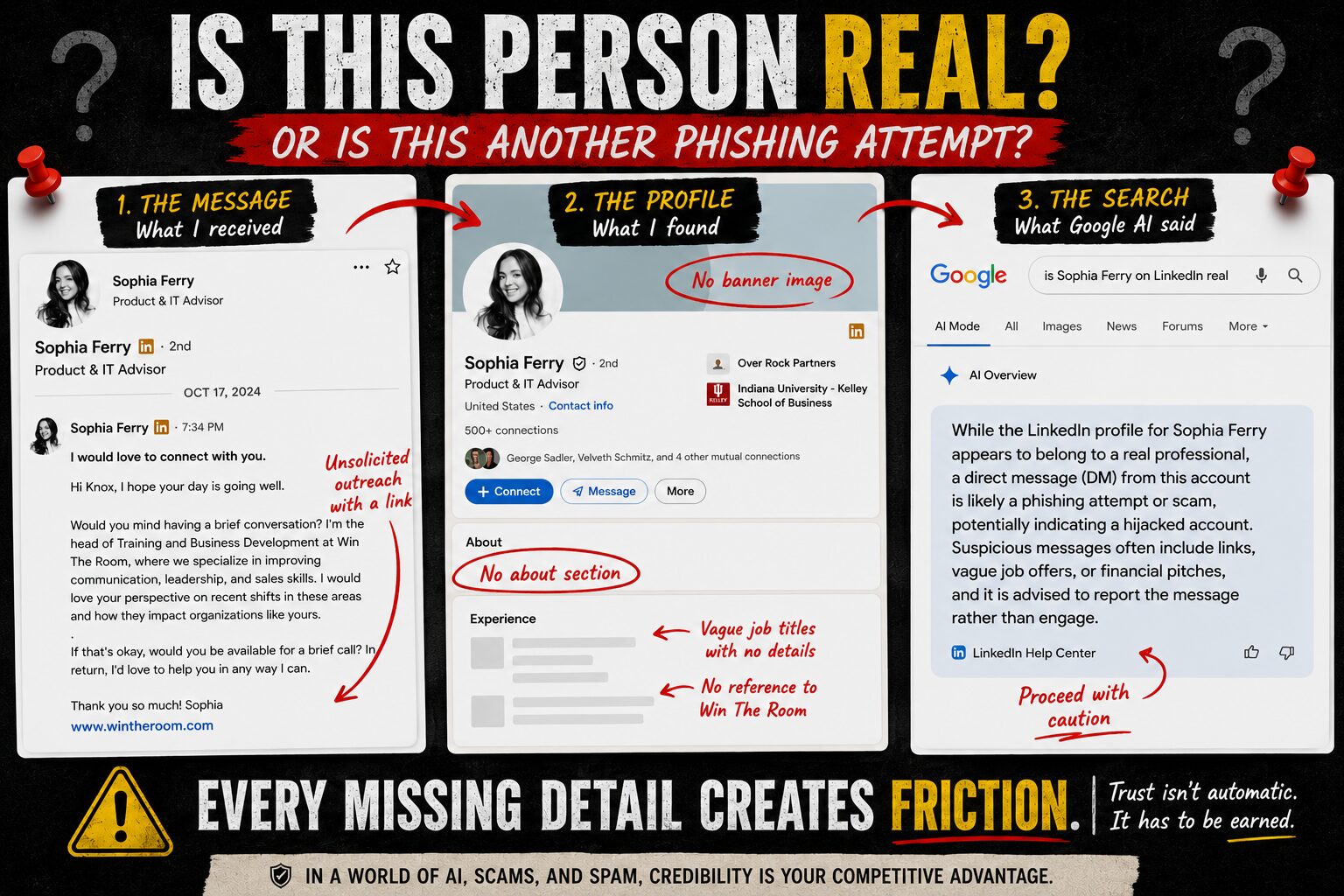
A LinkedIn message landed in my inbox recently. At first glance, it seemed harmless. A professional named Sophia Ferry reached out asking for a brief conversation. She mentioned leadership development, communication skills, and business development. She included a company website url in the message and requested a short call.
Nothing unusual.
Or was it?
My first reaction wasn’t curiosity.
It was skepticism. Not because of the message itself. But because of the environment we all operate in today.
Every day we’re bombarded with:
- phishing emails
- fake LinkedIn profiles
- AI-generated outreach
- spam text messages
- robocalls
- impersonation scams
Trust has become expensive. So before I clicked anything, I started investigating.
Step 1: Her LinkedIn profile is only partially completed.
The account had a customized LinkedIn URL. That’s generally a positive sign. But then I started looking closer.
Things that were missing:
- No banner image
- No About section
- No contact information
- No meaningful job descriptions
- No explanation of accomplishments
- No mention of the company website referenced in the message
None of these items prove the profile is fake. But collectively, they create uncertainty. And uncertainty creates friction.
Step 2: The company mentioned in the message was not clearly connected to experience section of the profile.
The message referenced Win The Room. But, the profile didn’t. That matters.
Because when someone reaches out to me, I immediately start trying to connect dots.
I ask myself:
- Is this person who they claim to be?
- Do they actually work where they say they work?
- Is this outreach legitimate?
- Why should I trust this request?
Every missing piece creates another question – more friction. Every question that goes unanswered creates another reason for me to move on.
Step 3: Google wasn’t much help.
So I Googled her. Google’s AI summary essentially said: The profile appears to belong to a real professional, but unsolicited outreach should be approached with caution because accounts can be hacked or impersonated.
Fair enough. But that didn’t increase trust. Instead, it simply reinforced uncertainty.
Here’s the important part:
Sophia Ferry may be completely legitimate. This isn’t a criticism of her. Instead, it’s a lesson for all of us.
Because whether she is real or not is almost beside the point. The issue is that she unintentionally introduced friction into our relationship before it ever started.
The Friction Test
Imagine meeting someone at a networking event. You walk up and say: “I’d love to talk with you.” Then immediately walk away before introducing yourself.
No business card. No context. No explanation. No way to reach you.
That’s essentially what many LinkedIn profiles do every day. They ask for trust before they’ve earned it.
A Better Way
If I were coaching someone on how to approach this outreach, I’d suggest three simple changes.
1. Connect before pitching.
Instead of sending a direct message to a stranger, send a personalized connection request first. Something like: Hi Knox, I enjoyed your work on Digital Validation and employee advocacy. I’m involved in leadership development and would love to connect and learn more about your perspective on these 3 topics…
Now the person knows:
- why you’re reaching out
- how you found me
- what the connection point is
This provides room for the future conversation to begin with context.
2. Complete your LinkedIn profile.
Your LinkedIn profile is not digital resume. Actually, it’s more important than your resume. It is the foundation for your digital footprint and credibility engine.
A resume is only seen after someone asks for it. And if you’re just hitting the apply button, less than 20% of resumes submitted this way are ever seen by human eyes.
Your LinkedIn profile, on the other hand, can be viewed at any time by anyone. Additionally, a resume shows you at one point in time and is rear facing. LinkedIn shows who you are right now and where you’re going in the future.
Crazy knowing this and knowing how many critical sections on LinkedIn are left blank. Did you know:
- Less than 30% of LinkedIn users have a substantially complete profile.
- Less than 17% include contact information.
Would you submit a resume with missing sections and no phone number? Of course not. Yet people do exactly that on LinkedIn every day.
3. Remove friction.
Make it easy for people to verify you. They will Google you, so on LinkedIn be sure to include:
- professional headshot
- banner image
- About section
- contact information
- detailed experience descriptions
- company website references
- recommendations
- featured media
The easier you are to verify, the easier you are to trust. And the easier you are to trust, the easier it is to start conversations.
The Bigger Lesson
The question isn’t: Is Sophia Ferry real?
The better question is: How much work should someone have to do before they believe you’re real?
In a world flooded with AI-generated content, phishing attacks, and fake profiles, credibility is becoming a competitive advantage. And, trust isn’t built when someone meets you.
Trust begins long before that. It begins when they Google you. When they visit your LinkedIn profile. When they evaluate whether you’re worth responding to.
Digital Validation™ isn’t about visibility. It’s about reducing uncertainty.
Because when people can quickly see who you are, what you do, and why you matter, conversations happen faster. And opportunities follow.
Final Thoughts
In 2026, being legitimate isn’t enough. You must also be verifiable.

And as always —

_______________________________________________________________________________________
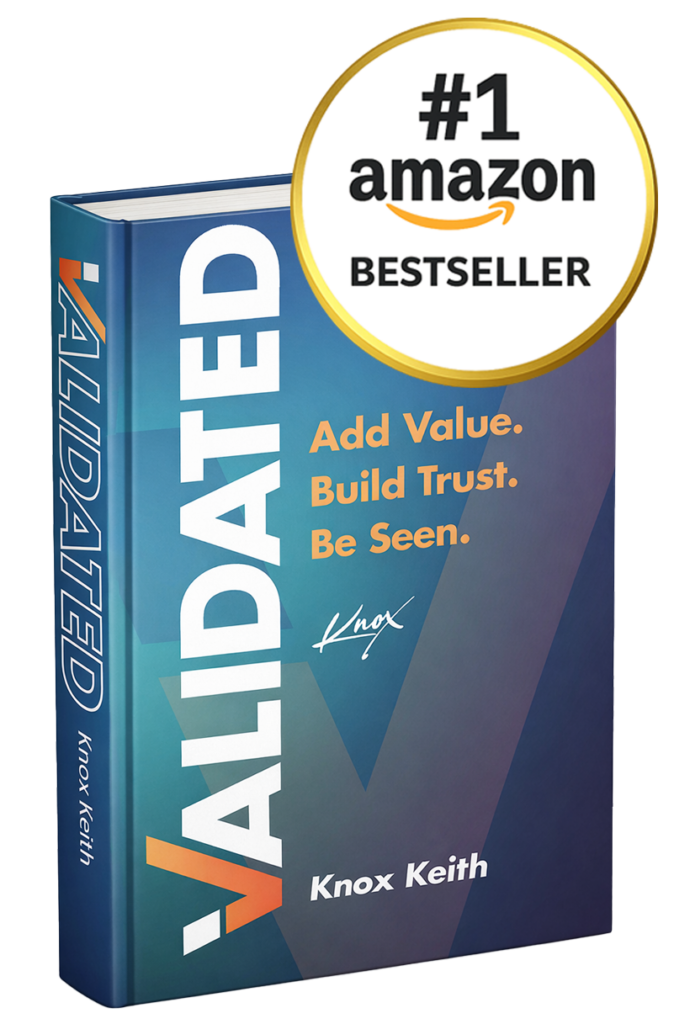
Knox Keith is a strategic advisor, corporate and MBA level instructor, Emmy-winning storyteller, and author of Validated: Add Value. Build Trust. Be Seen. He has spent 30+ years helping professionals and organizations build credibility, communicate with clarity, and show up with confidence in the modern digital world.
___________________________________________________________________________________
➡️ Get Validated: Add Value. Build Trust. Be Seen. — your roadmap out of the crisis: https://www.amazon.com/dp/B0GQ57HLXM
➡️ Join the Digital Validation™ program — https://knoxkeith.com/courses/
➡️ Give me a follow on LinkedIn: www.linkedin.com/in/knoxkeith
➡️ Subscribe to my newsletter: https://validatedbyknox.mykajabi.com/newsletter
Frequently Asked Questions (FAQs): Is This Person Real? The New Cost of Digital Friction
For CHROs:
What does digital friction cost an organization when employees have incomplete LinkedIn profiles? More than most HR leaders realize. When a sales rep, recruiter, or executive reaches out on behalf of your company, their LinkedIn profile is a proxy for your brand. If the profile looks unfinished or unverifiable, the recipient doesn’t just doubt the individual — they doubt the organization. Employee advocacy only works when employees are credible. An incomplete profile doesn’t just hurt the individual. It creates reputational friction for the company they represent.
Should digital presence be part of employee onboarding or professional development programs? It should — and it isn’t, in most organizations. Companies invest heavily in communication training, leadership development, and brand standards. But almost none of that investment includes teaching employees how to show up professionally online. That’s a gap. In a world where anyone can be Googled before a meeting, a call, or a hiring decision, digital credibility is a professional skill. It belongs in the development curriculum.
For CGOs:
Q: How does a sales rep’s LinkedIn profile affect whether prospects respond to outreach? Directly. Before a prospect responds to a cold message, they check the profile. If the profile is thin, unverifiable, or inconsistent with the message, the outreach gets ignored — or worse, flagged as suspicious. Your reps may have the right message and the right target. But if their digital presence creates friction, the conversation never happens. Digital Validation™ training helps sales teams remove that friction before the first touch.
What is digital friction and why does it matter? Digital friction is anything that slows down or stops someone from trusting you. A missing banner image. No About section. A job title with no description. None of these things, individually, prove you’re a scammer. But together? They create doubt. And doubt creates hesitation. And hesitation kills conversations before they start.
I’m not a salesperson. Why does any of this apply to me? Because everyone gets evaluated online. Hiring managers. Potential clients. Conference organizers. Journalists. Collaborators. Anyone who might want to work with you will Google you first and check your LinkedIn profile. If they can’t verify who you are quickly, they move on. You don’t get a second chance to make a first digital impression.
Does an incomplete LinkedIn profile mean someone is a scammer or fake? No. That’s not the point. Sophia Ferry may be completely legitimate. The issue isn’t intent. The issue is outcome. An incomplete profile introduces uncertainty. And in a world full of AI-generated outreach, phishing attempts, and impersonation scams, uncertainty gets treated the same as a red flag.
What sections of a LinkedIn profile matter most for building trust? Start with the basics that get people to stop and stay:
- A professional headshot
- A banner image
- An About section written in your own voice
- Contact information
- Detailed experience descriptions that match the companies and roles you’re actually promoting
Every one of these is a trust signal. Every one that’s missing is a question mark.
Why does the company referenced in an outreach message need to appear on the LinkedIn profile? Because people are connecting dots. When someone reaches out mentioning a company, the first thing the recipient does is check the profile. If the profile doesn’t match the message, the disconnect creates doubt. It’s that simple. Make it easy for people to verify the claim you just made.
What did Google’s AI actually say about Sophia Ferry’s profile? Google’s AI summary said the profile appeared to belong to a real professional, but flagged the direct message outreach as a potential phishing attempt or scam. It recommended proceeding with caution. That’s not an indictment of Sophia. That’s what AI is trained to say when the signals don’t add up. Which is exactly the problem.
How should someone approach LinkedIn outreach to avoid triggering skepticism? Send a connection request first. Not a message. A request. Include a brief, personalized note explaining who you are, how you found them, and why you want to connect. Give the person context before you ask for their time. That one step eliminates most of the friction before the real conversation even begins.
Is Digital Validation™ about being visible, or is it about something more specific? Both. Visibility matters. But visibility without credibility is just noise. Digital Validation™ is about building a presence that is consistent, professional, and easy to verify — so that when someone searches your name, they find evidence that you are who you say you are. The goal isn’t to be seen. The goal is to be believed.
What’s the difference between being legitimate and being verifiable? Legitimate means you’re the real deal. Verifiable means other people can confirm it without your help. In 2026, you need both. Your reputation doesn’t just live in your head or in the memories of people who’ve met you. It lives on the internet. And what people find when they search your name is now your first impression — whether you like it or not.
How do recommendations and featured media help with trust? They serve as third-party proof. Anyone can write a polished About section. But recommendations from colleagues, clients, and managers show that other real people will vouch for you. Featured media — articles, videos, presentations — shows that your expertise exists somewhere beyond your own profile. That kind of social proof reduces uncertainty fast.