
The Awareness-to-Consideration gap nobody is funding — and why CHROs and CGOs are both paying for it.
You’ve in the meetings. Sales blames Marketing. Marketing blames Sales. And the CHRO isn’t even in the room.
This revenue dynamic plays out inside organizations every day. And it’s costing companies more than they realize. Not just in pipeline, but in talent, in employer brand, and in the trust that drives every decision a buyer, a candidate, or a partner makes before they ever raise their hand.
Here’s what’s actually happening. And more importantly, here’s who needs to be in the room to fix it.
The Funnel Everyone Knows and Nobody Is Fixing
Every marketer knows the funnel: Awareness. Consideration. Purchase.
Most organizations invest heavily at the top – thinking things like impressions, reach, brand campaigns, and content volume matter. And then they are baffled when the pipeline doesn’t follow.
So Marketing points to the numbers: “We generated 50,000 impressions this month.”
Sales claps back: “Nobody’s converting.”
Both are right. And both are missing the real problem.
The gap isn’t at the top of the funnel. It isn’t at the bottom either. It’s in the middle and nobody is addressing it: How do you move people from Awareness to Consideration?
The move is not a media buy. It isn’t a better email sequence or a more optimized landing page.
Instead, it’s a trust decision. And trust doesn’t get built by a campaign. It gets built by your people adding value over time. Specifically, trust gets built when the people behind your brand — your executives, your sales team, your subject matter experts — show up adding value consistently over time. That builds the credibility that a prospect decides you’re worth a closer look.
The Problem I’ve Seen Up Close
I’ve built employee advocacy programs for companies like Dell and AT&T — helping them gain share of voice on specific topics in their industries. And I’ve trained B2B sales teams on what it actually takes to move a prospect from cold awareness to genuine consideration.
The insight that shifted everything for those sales teams wasn’t about better pitches or smarter sequences.
It was this: Only 3% of LinkedIn members post more than once a week — which means the professionals who show up consistently with credible content aren’t competing in a crowded space. Instead, they are operating in a nearly empty one.
And 97% of B2B marketers report using LinkedIn as their primary platform for content distribution, while a fully complete LinkedIn profile gets 21 times more profile views and 36 times more messages. The gap between showing up and not showing up is not marginal. It’s enormous
Think about what that means for a buyer doing research.
They’re not waiting for your email. They’re not reading your newsletter. Before they respond to anything, they’re doing exactly what you’d do — they’re Googling the person who reached out. They’re checking LinkedIn. They’re forming an impression in about 30 seconds based on what they find.
And in most cases? What they find is a profile that hasn’t been touched in three years, no visible expertise, no evidence of how that person thinks or what they bring to the table.
The impression isn’t neutral. It’s a reason to hesitate and to say No.
“Known Before They Walked Into the Room”
After implementing a Digital Validation™ program with one B2B sales team — focused specifically on the Adding Value piece of building trust — the feedback from the sales leader landed in one sentence: “Our reps were known before they walked into the room.”
That’s the Awareness-to-Consideration gap closing in real time.
Not because the reps posted more. But because they showed up with visible credibility — specific expertise, genuine perspective, a professional presence that gave prospects something to trust before the first conversation began.
The result wasn’t just better sales. It was shorter sales cycles. Warmer first meetings. And a fundamentally different dynamic, because the rep wasn’t starting from zero — they were continuing a relationship the prospect had already begun, quietly, on their own.
Think about that in the context of relationship-building at the executive level. For years, business relationships were built on golf courses, at dinners, at conferences — high-touch, low-scale. Those interactions still matter. But they’re available to a limited number of people.
Digital credibility democratizes that. It lets every rep, every executive, every subject matter expert build the kind of familiarity and trust that used to require an invitation to tee time.
Where the CHRO Comes In
Here’s what most organizations miss entirely: this isn’t just a Sales problem or a Marketing problem. It’s a talent and organizational development problem — which means the CHRO owns a piece of it whether they know it or not.
When employees — at any level — lack the professional presence to show up credibly in the moments that matter, it affects more than pipeline:
- Recruiting suffers. Candidates research the people they’d work with before accepting offers. Invisible or underdeveloped professional profiles create hesitation in a talent market where hesitation loses the hire.
- Employer brand weakens. The external signal of your organization isn’t just your careers page. It’s the aggregate of how your people show up publicly — in their profiles, in their content, in their engagement.
- Leadership transitions become riskier. When executives are promoted or moved into external-facing roles without a credible professional presence, they’re starting from scratch in a moment that demands trust.
The CHRO who sees this clearly doesn’t just own onboarding and performance reviews. They own the professional credibility infrastructure that makes everything else — sales, recruiting, retention, leadership development — work better.
That’s not a training program. That’s a strategic capability.
The CGO’s Version of the Same Problem
For the Chief Growth Officer, the Awareness-to-Consideration gap shows up in the metrics that matter most: pipeline conversion, customer acquisition cost, and the effectiveness of demand generation spend.
When content generates impressions but not qualified inbound leads, that’s the trust gap made visible. When sales cycles are longer than they should be, that’s the credibility gap slowing the middle of the funnel. When marketing spend keeps increasing but pipeline quality doesn’t follow, the instinct is to optimize the campaign.
The real fix is upstream.
The question isn’t “how do we get more attention?” That’s a solved problem — attention is cheap and getting cheaper every day as AI floods every platform with more content than anyone can consume.
The real question is: “How do we build trust before the first conversation happens?” That’s a Digital Validation™ question. And it sits at the intersection of marketing strategy, sales enablement, and human capital development — which is exactly why it keeps falling through the cracks between departments.
The Organizational Blind Spot
Sales and Marketing argue about the handoff. Meanwhile, nobody is asking: “Are our people credible enough to move a prospect from curious to convinced?”
That question doesn’t live in the marketing budget. It doesn’t live in the sales training budget. It lives in the gap between them — and right now, most organizations are leaving it completely unaddressed.
The companies getting this right aren’t running bigger campaigns or adding more salespeople to the top of the funnel. Instead, they are investing in something more fundamental: building the professional credibility of their people so that every touchpoint — every email, every LinkedIn search, every Google result — builds trust rather than creating doubt.
That investment pays off in pipeline. It pays off in talent. It pays off in the speed and quality of every decision a buyer or candidate makes.
And it starts with a simple diagnostic: If a prospect or a candidate searched three of your key people right now — what would they find? Would it build trust? Or would it create hesitation?
That answer is your gap. And it’s fundable.
This Is a Moment, Not a Trend
AI is accelerating this problem faster than most organizations realize. As content volume explodes and AI-generated messaging becomes indistinguishable from human-generated messaging, the premium on authentic human credibility is going up — not down.
The organizations that invest now in building genuine professional presence across their teams will have a compounding advantage. The ones that wait will find themselves in a trust deficit that no campaign budget can close.
The gap between awareness and consideration has always been about trust. It’s just never been this expensive to ignore.
Ready to Close the Gap?
If this resonates — whether you’re leading growth, leading people, or leading a sales organization — the framework is in the book.
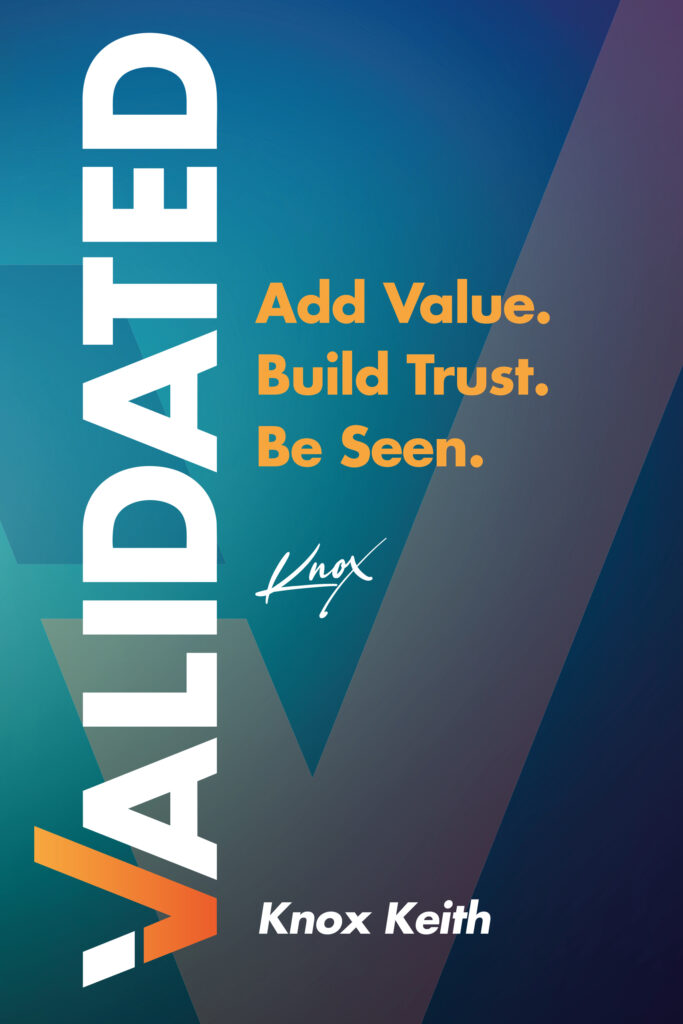
Validated: Add Value. Build Trust. Be Seen. is the playbook for building Digital Validation™ across individuals and organizations — the disciplined building of a strong, consistent, and professional online presence that earns trust and creates real opportunity.
And if you want a practical, self-directed program for building that presence right now, the Digital Validation™ Course is built for exactly this moment.
The gap is real. It’s measurable. And it’s closeable.

And as always —

_________________________________________________________________________________________________________________________________________________
Knox Keith is a strategic advisor, corporate and MBA level instructor, Emmy-winning storyteller, and author of Validated: Add Value. Build Trust. Be Seen. He has spent 30+ years helping professionals and organizations build credibility, communicate with clarity, and show up with confidence in the modern digital world.
_________________________________________________________________________________________________________________________________________________
➡️ Get Validated: Add Value. Build Trust. Be Seen. — your roadmap out of the crisis: https://www.amazon.com/dp/B0GQ57HLXM
➡️ Join the Digital Validation™ program — https://knoxkeith.com/courses/
➡️ Give me a follow on LinkedIn: www.linkedin.com/in/knoxkeith
➡️ Subscribe to my newsletter: https://validatedbyknox.mykajabi.com/newsletter
#Sales #Marketing #Conversation #SalesFunnel #CHRO #CGO #Trust #Credibility
Frequently Asked Questions: Awareness, Consideration, and the Trust Gap
Why aren’t prospects converting despite strong awareness metrics? Because awareness and trust are different things — and only one of them drives decisions. High impressions with low conversion is almost always a symptom of a credibility gap in the middle of the funnel. Prospects found you, evaluated you, and didn’t find enough proof to move forward. The fix isn’t more reach. It’s more substance behind the visibility.
What is the Awareness-to-Consideration gap and why does it matter? It’s the space between “I’ve heard of this company or person” and “I trust them enough to engage seriously.” Most organizations invest heavily in generating awareness and then assume conversion will follow. It doesn’t — not without the trust layer in between. That layer is built by the credibility of the people behind the brand, not by the campaigns promoting it.
How does LinkedIn presence affect B2B sales conversion? Significantly — because buyers research the people they’re evaluating, not just the companies. Less than 30% of LinkedIn users have a fully optimized profile, and less than 11% log in daily. That means most sales professionals are invisible or underdeveloped in the exact place buyers go to form their first impression. A rep or executive with a credible, specific, active LinkedIn presence is already building trust before the first conversation. One without it is starting every interaction from zero — or from doubt.
Why is this a CHRO issue, not just a Sales and Marketing issue? Because professional credibility is a workforce capability, not just a communications tactic. When employees lack the digital presence to show up credibly in sales conversations, recruiting interactions, or leadership moments, that’s a development gap — which sits squarely in the CHRO’s domain. Organizations that treat Digital Validation™ as a strategic capability rather than an individual responsibility see returns across talent acquisition, employer brand, retention, and sales effectiveness simultaneously.
What does it mean to be “known before you walk into the room”? It means a prospect, candidate, or partner has already formed a positive impression of you before the first interaction — because they found your professional presence online and it gave them a reason to trust you. That’s the outcome of Digital Validation™ done well. It compresses the trust-building timeline, warms every conversation, and fundamentally changes the dynamic from “let me convince you” to “let’s continue a conversation you’ve already started.”
How does Digital Validation™ differ from personal branding? Personal branding is often focused on image — how you look, how you’re perceived, how you market yourself. Digital Validation™ is focused on proof — demonstrating expertise, building trust, and creating a professional presence that validates your credibility before anyone asks for it. The distinction matters because audiences in 2026 are sophisticated enough to recognize performance. What they respond to is substance. Digital Validation™ is the disciplined building of a strong, consistent, and professional online presence that earns trust and creates real opportunity — not one that merely claims it.
Why is this problem getting more urgent in 2026? Because AI is flooding every platform with content at a scale that makes attention cheaper and trust scarcer than ever. As AI-generated messaging becomes harder to distinguish from human messaging, the premium on authentic, verifiable human credibility goes up. Organizations that invest in building genuine professional presence now — across their sales teams, their executives, and their workforce — will have a compounding trust advantage. The ones that wait will face a credibility deficit that no campaign budget can close.
Knox Keith is a management consultant, Emmy-winning storyteller, and author of Validated: Add Value. Build Trust. Be Seen. He has spent 30+ years helping professionals and organizations — including Dell, AT&T, and leading B2B companies — build credibility, communicate with clarity, and show up with confidence in the modern digital world.